
Penalty Calculator IRS: Estimate Your Tax Penalties Before You Pay
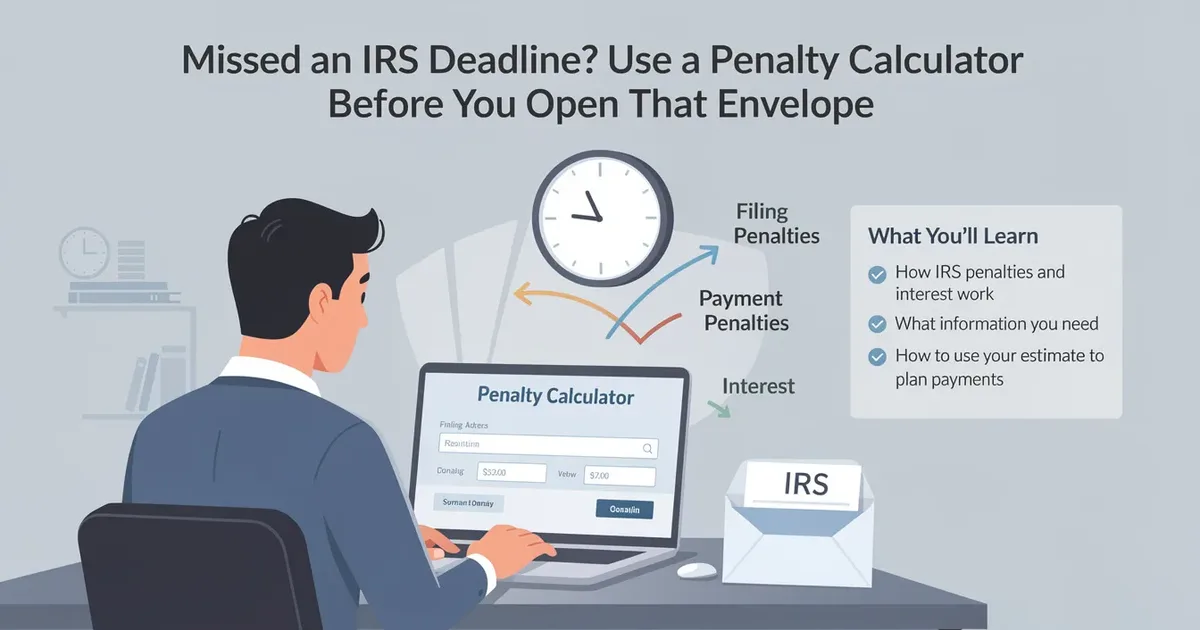
If you owe the IRS and missed a deadline, the clock is already ticking. Using a penalty calculator IRS helps estimate penalties for filing and payment delays before you open that dreaded envelope. This guide walks you through exactly how IRS penalties and interest work, what inputs you need, and how to use your estimate to make smarter payment decisions.
Quick Answer: How to Estimate Your IRS Penalties Right Now
An IRS penalty calculator estimates three things: your late filing penalty, your failure to pay penalty, and the interest that accrues on your unpaid tax from the due date until you pay. To estimate penalties, gather your tax year, amounts owed, and key filing dates-then let the calculator do the math.
Here's what you need to run a reliable estimate:
The tax year in question (e.g., your 2025 tax return due April 15, 2026)
The total amount of tax owed on the return after withholding and refundable credits
The actual filing date (or when you expect to file)
The payment date when you plan to pay in full
Calculators use current IRS interest rates and penalty rates to approximate what the Internal Revenue Service will charge. But keep in mind: the IRS does not provide an official penalty calculator on its website. Taxpayers can use reputable third-party calculators to estimate penalties online, though the official number will appear on an IRS notice or transcript. Calculators often provide estimates and may not reflect the exact IRS balance owed.
You should run a penalty calculator immediately if you're filing a return several months late, carrying a large unpaid balance after April 15, or you missed quarterly estimated tax payments on self-employment income. ClearNotice complements any online penalty or interest calculator by helping you understand the IRS letters that show your final penalties and interest amounts in plain English.

How IRS Penalties Work: The Basics You Need to Know
IRS penalties are extra charges on top of the original tax owed when you miss deadlines or underpay during the tax year. They're statutory-meaning they kick in automatically unless you qualify for relief.
The most common tax penalties individuals face include:
Late filing penalty (failure to file) – for not submitting your return by the due date
Failure to pay penalty – for not paying your tax bill by the deadline
Estimated tax penalty – when paycheck withholding and estimated payments fall short
Dishonored check penalty – if a payment bounces or is returned for insufficient funds
Accuracy-related penalties – the accuracy related penalties apply for underreporting income tax or overstating deductions, including cases of substantial understatement
Failure to Deposit Penalty – applies to late employment taxes and payroll taxes deposits
IRS penalties are calculated based on the unpaid tax amount and time elapsed. The IRS also charges daily compounded interest on unpaid tax and, in many cases, on unpaid penalties. Filing penalties are triggered by late returns; payment penalties are triggered by unpaid balances after the deadline. For example, for a 2025 return, the due date is April 15, 2026. If you filed a payment extension, the filing deadline moves to October 15, 2026, but your tax payment is still due April 15.
The IRS will generally first assess the tax shown on your return, then apply penalties, and then charge interest on both. Understanding how they stack up matters before you decide when and how to pay taxes.
Key Inputs Every IRS Penalty Calculator Needs
Most penalty calculators ask the same core questions to mirror how the IRS calculates penalties. Here are the required inputs:
Tax year: 2024, 2025, etc.
Original due date: April 15, 2025 or April 15, 2026
Whether you timely filed or filed late
Amount of tax owed on the original return (after credits and tax withholding)
Date you actually paid or plan to pay
Optional but useful inputs include partial payment dates and amounts, whether an extension was filed, and whether you're in an installment agreement.
Calculators typically assume no penalty abatement, no audit adjustments, and no prior-year carryovers. Your actual tax situation might differ from the estimate.
Here's a sample input: you owe $7,500 for your 2025 return. You filed June 30, 2026 (no extension), and plan to pay September 1, 2026. A calculator would estimate your late filing penalty, failure to pay penalty, and interest across those periods.
Failure to File vs. Failure to Pay Penalty
These are separate charges that many calculators estimate together, but they operate at very different rates.
Failure to file penalty:
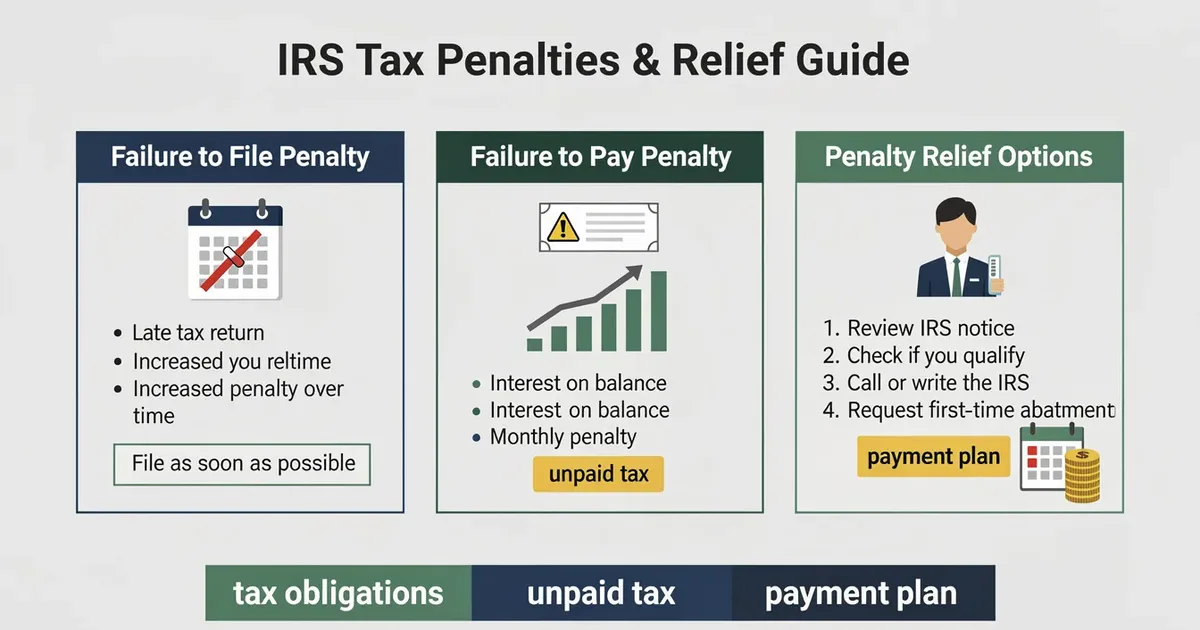
The failure-to-file penalty is 5% of unpaid tax per month or partial month, calculated from the due date
The maximum failure-to-file penalty caps at 25% of unpaid tax
If a return is more than 60 days late, a minimum penalty of $525 or 100% of the tax owed (whichever is less) applies
Failure to pay penalty:
The failure-to-pay penalty is 0.5% of unpaid tax per month or partial month after the due date
The maximum failure-to-pay penalty is 25% of unpaid taxes
After a final notice of intent to levy, the rate increases to 1% per month
Under an installment agreement, it drops to 0.25% per month
When both penalties apply in the same month, the IRS caps the combined rate at 5% total (4.5% for late filing plus 0.5% for late payment). Calculators approximate this combined effect.
Example: Your 2025 return is due April 15, 2026. You file August 20 (4 months late) and pay the $5,000 balance November 1. The late filing penalty would be roughly 4 × 5% = 20%, or $1,000. The failure to pay penalty accrues at 0.5% per month from April through November-about 3.25%, or ~$163. Interest accrues on top of both.
Estimated Tax Penalty and Underpayment of Estimated Taxes
The U.S. income tax system is pay-as-you-go. Your tax withholding from wages and quarterly estimated tax payments should cover your tax liability throughout the year. When they don't, the IRS charges penalties for underpayment of estimated tax.
You owe a penalty if you underpay estimated taxes by over $1,000 at filing. The underpayment of estimated tax penalty isn't a flat fee-it's an interest-style charge calculated based on the shortfall in each quarter's required payment. A good penalty calculator will break this down by period.
Form 2210 helps calculate the underpayment penalty amount on the actual return. An online calculator can show an estimate before you file, which is especially useful for self-employed individuals who make quarterly payments or those with self employment tax obligations.
Safe harbor rules can help you avoid penalties. If you paid at least 90% of your current-year tax or 100% of your prior-year tax liability (110% if your AGI exceeded $150,000), you generally won't face an IRS underpayment penalty. Some calculators ask for prior-year tax to evaluate whether a safe harbor applies.
How the IRS Charges Interest (and How an Interest Calculator Imitates It)
Separate from penalties, the IRS charges interest on unpaid tax starting from the original due date-regardless of whether you filed an extension. Interest also accrues on unpaid penalties in many cases.
The IRS interest rate equals the federal short-term rate plus 3%, changes quarterly, and is compounded daily. Interest rates for underpayment penalties change quarterly. As of July 2026, interest rates for underpayments hover around 7% annually for individuals.
An interest calculator uses current and historical quarterly rates to calculate interest from the due date until the payment date. These tools assume no additional IRS assessments, no interest suspension, and no retroactive penalty relief.
Quick example: On $10,000 of unpaid tax for 120 days at 7% annually, you'd accrue roughly $230 in interest alone. Add the failure to pay penalty (about 2% over four months) and the total extra cost approaches $430. The actual IRS computation might differ slightly due to daily compounding and rate changes, but this gives you a realistic ballpark.
Using a Penalty Calculator for Different Tax Situations
The same calculator logic applies across scenarios, but your specific tax situation shapes the result. Common profiles include:
W-2 employees whose paycheck withholding didn't cover enough tax, resulting in overdue taxes
Self-employed individuals who skipped quarterly estimated tax payments on income not subject to withholding
Retirees with new investment income where no tax withholding mechanism existed
Late filing with a refund generally doesn't trigger a failure to pay penalty or IRS interest, because there's no unpaid tax. But late filing with tax owed almost always does-and a calculator will highlight this instantly when you enter dates and balances.
Some calculators can compare options: paying in full now versus setting up a payment plan, showing how late payment penalties and interest change over time. These tools are most valuable before making payment decisions. Run the numbers before waiting another month while your overdue taxes remain unpaid.
Debt Management Options After You See the Penalty Estimate
Seeing the total projected penalties and interest helps you choose the right path forward. Your main options:
Option | Penalties Stop? | Interest Stops? | Best For |
|---|---|---|---|
Pay in full now | Yes | Yes | Anyone with sufficient funds |
Short-term payment plan (≤180 days) | Continues at 0.5%/mo | Continues | Balances under $100K |
Long-term installment agreement | Reduced to 0.25%/mo | Continues | Larger balances paid monthly |
Offer in Compromise | Negotiated | Negotiated | Genuine financial hardship |
A calculator can show how continuing to carry a balance causes penalties and interest to compound each month. For instance, keeping a $5,000 balance unpaid for six extra months costs roughly $150 in failure to pay penalty plus $175 in interest-money you could save by acting sooner.
Formal installment agreements don't stop interest, but they reduce the failure to pay penalty rate and help you avoid aggressive IRS collection actions like levies or liens. If you can't pay anything, the IRS may place your account in Currently Not Collectible status, though penalties and interest keep accruing.
Reducing or Removing IRS Penalties: Abatement and Relief
Calculators generally assume no penalty relief, but actual IRS penalties can sometimes be reduced or removed.
The IRS may grant first-time penalty abatement for certain penalties if you have a clean compliance history for the prior three years, have timely filed all required returns, and paid or arranged to pay taxes owed. This typically covers failure to file and failure to pay penalties-not the estimated tax penalty or accuracy related penalties. Starting January 1, 2027, the IRS is replacing this with an Automatic Exemption from Penalty for eligible taxpayers.
The IRS considers reasonable cause for penalty abatement requests. Concrete examples include serious illness, a natural disaster, or reliance on incorrect written IRS advice. You can dispute an IRS penalty by writing a letter explaining your circumstances. IRS penalties can be disputed by providing supporting documents-medical records, FEMA declarations, or IRS correspondence. A reasonable attempt to comply, even if unsuccessful, strengthens your case. The IRS treats these requests seriously and typically takes 30 to 60 days to process abatement requests.
Interest usually can't be abated unless the underlying penalty is removed or the IRS caused an unreasonable delay. So your interest calculator estimates are often close to final. Compare your calculator result with the amount on your IRS notice, then consider requesting abatement if you qualify.
If someone asks you to intentionally ignore your tax obligations, walk away. The IRS applies penalties aggressively when it detects willful non-compliance.
Reading IRS Notices That Show Your Actual Penalties and Interest
After filing a late return or leaving a balance unpaid, the IRS typically sends a notice listing tax owed, penalties, and interest. Common notices include CP14 (first balance due notice), CP501, and CP504 (escalating reminders).
Key sections to compare against your penalty calculator estimate:
Amount You Owe – total including tax, penalties, and interest
Penalty Explanation – which penalties apply (late filing, late payment, etc.) and for which months
Interest Charges – the rate and accrual period through the notice date
ClearNotice helps here: upload your notice and get a plain-English breakdown of which portions are tax, failure to file penalty, late payment penalties, and estimated tax penalty, plus critical deadlines and response options.
Discrepancies between a calculator's estimate and the IRS notice can result from prior-year balances, IRS adjustments, social security tax issues, or additional interest periods you didn't model. Always use the notice as your ground truth-and a tax professional for a free consultation if the numbers don't add up.

How to Avoid IRS Penalties Going Forward
A penalty calculator isn't just for damage control. It's a planning tool that helps you avoid penalties in the future and meet your tax obligations year-round.
Specific prevention strategies:
Adjust tax withholding using Form W-4 whenever your income changes-new job, side gig, or investment income
Set calendar reminders for quarterly estimated tax payments: April 15, June 15, September 15, and January 15
Review your income mid-year; if it spikes, re-estimate your tax liability and make an additional tax payment
File on time, even if you can't pay the full amount-the late filing penalty at 5% per month is ten times steeper than the late payment penalty at 0.5%
Periodically run an estimated tax or withholding calculator during the year to confirm you're paying enough tax. Under tax laws, the pay-as-you-go system means shortfalls discovered in December are much harder to fix than those caught in June. And estimated payments made on time keep you inside the safe harbor, even if your final balance shifts.
When future IRS letters arrive-and they might-ClearNotice can help you quickly decode what they say about penalties so you can act before interest and additional IRS charges build up. The sooner you estimate, the sooner you can act and stop penalties from growing.
Keep reading
 Penalties & abatement
IRS Insufficient Funds Penalty: What to Do Next: IRS Guide
If your IRS payment bounced, a dishonored payment penalty may already be on your account. This guide explains how the IRS insufficient funds penalty works and what to do fast.
 Penalties & abatement
IRS Underpayment Penalties: What You Need to Know: IRS Guide
The IRS charges underpayment penalties when you don't pay enough tax throughout the year. This plain-English guide explains how the penalty is calculated and how to avoid it.
 Penalties & abatement
Penalties for IRS: Failure to File, Pay & Penalty Relief
Received an IRS notice about a penalty? This guide breaks down the most common IRS penalties in plain English, including how they are calculated and your options for relief.