
Penalty for Late IRS Filing: Failure to File vs. Failure to Pay

Filing taxes late when you owe money to the Internal Revenue Service triggers two separate penalties and daily-compounding interest. Here is how each one works, what they cost, and how to reduce or eliminate them.
Overview: What Happens If You File Taxes Late?
Missing the April 15 due date for your federal income tax return (or the October 15 extension deadline) can trigger the penalty for late IRS filing if you owe money: the IRS generally charges a failure to file penalty of 5% of unpaid tax per month or partial month, up to 25%, a failure to pay penalty of 0.5% per month or partial month, up to 25%, plus daily compounding interest on the unpaid balance. If the IRS owes you a refund, there is no penalty for filing late, but you generally have only three years from the original deadline to claim it before the refund is lost.
If you owe the IRS and need to know what happens when you file your federal return late, this guide explains how late filing and late payment penalties work, how interest is added, the most common penalty situations, and the main ways to avoid, reduce, or get relief from these charges. Knowing the rules matters because penalties and interest can grow quickly and make an already unpaid tax bill much more expensive.
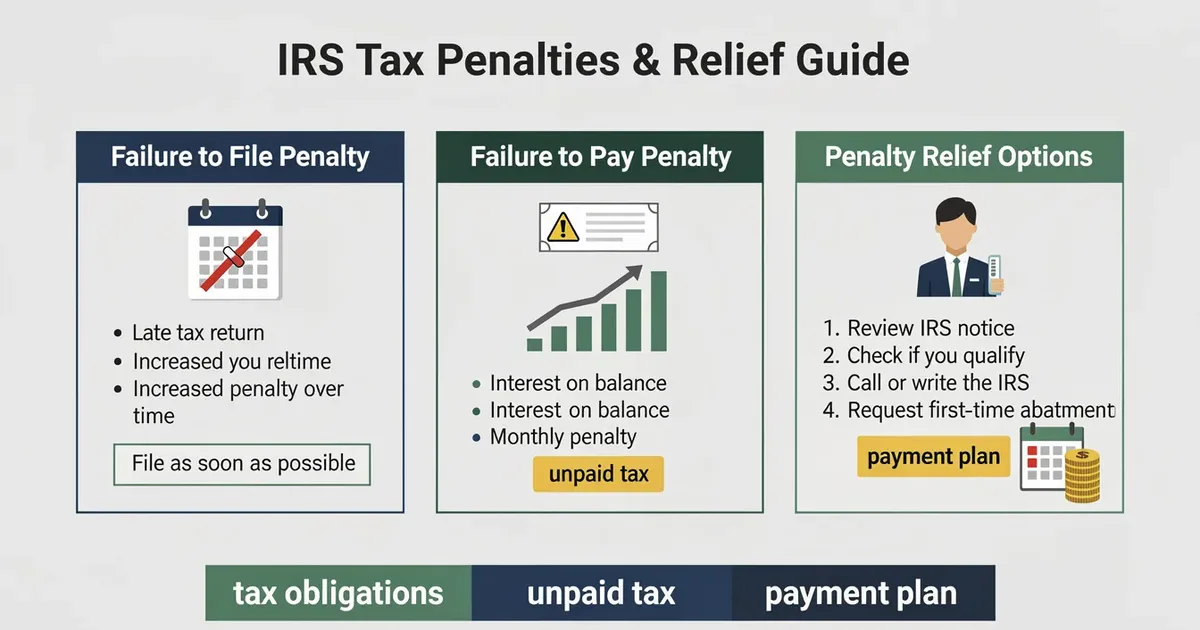
Two penalties apply when you file late and owe money:
The failure to file penalty: 5% of unpaid tax per month or partial month, up to 25%.
The failure to pay penalty: 0.5% of unpaid tax per month or partial month, up to 25%.
IRS interest accrues daily on your unpaid balance, separate from both penalties.
Key points to keep in mind for the 2025 tax year:
Filing an extension does not extend the time to pay taxes owed. You still owe interest and the late payment penalty from tax day forward.
Penalties and interest are based on your tax owed after withholding, estimated tax payments, and allowed refundable credits.
File taxes and pay as much tax by the due date as you can to avoid penalties, even if you cannot pay in full.

Failure to File Penalty: How the Late Filing Penalty Works
The failure to file penalty applies when you do not file your return by its due date and you still have unpaid tax. The IRS charges this penalty under IRC § 6651(a)(1).
Key figures:
Detail | Amount |
|---|---|
Rate per month or fraction thereof | 5% of unpaid tax |
Maximum penalty | 25% of unpaid tax |
Minimum penalty (return over 60 days late) | Lesser of $435 or 100% of unpaid tax |
The late filing penalty is 5% per month of unpaid tax, and the maximum late filing penalty is capped at 25%. The calculation base is the tax required on the date of the return minus payments made on time (withholding, estimated tax, refundable credits). A minimum penalty of $435 applies if returns are over 60 days late; for tax returns required after December 31, 2025, that minimum rises to $525.
Example: You owe $2,000 on your 2025 Form 1040 and file your return three full months late with no tax extension. The file penalty equals 5% × 3 × $2,000 = $300. The pay penalty adds 0.5% × 3 × $2,000 = $30. But when both failure to file and failure to pay penalties apply in the same month, the combined rate is generally capped at 5% (4.5% FTF + 0.5% FTP), not 5.5%.
Filing as soon as possible stops the 5% per month failure to file penalty from growing. After that, only the lower failure to pay penalty and interest continue.
Failure to Pay Penalty and Late Payment Penalties
The failure to pay penalty applies when the total tax shown on your return is not fully paid by the original due date, even if you filed on time or got a time to file extension. The penalty is 0.5% per month on unpaid taxes that remains unpaid, capped at 25%.
Rate changes under the IRS penalty rules based on your situation:
Standard rate: 0.5% per month of unpaid tax. The late payment penalty is 0.5% per month of unpaid tax until the balance is fully paid or the maximum penalty of 25% is reached.
After IRS notice: If the IRS determines you owe and you do not pay within 21 days of receiving an IRS notice demanding payment, the rate doubles to 1% per month. The failure continues until you pay or reach the cap.
Installment agreement: If you enter a qualifying installment agreement, the rate drops to 0.25% per month while the agreement is active. The pay penalty continues at this reduced rate.
Comparison: Taxpayer A files on time but pays a $3,000 tax bill three months late. FTP only: 0.5% × 3 × $3,000 = $45, plus interest. Taxpayer B files and pays three months late. Combined penalties per month are 5% (4.5% FTF + 0.5% FTP), totaling roughly $450, plus interest. Filing late when you owe tax costs ten times more than paying late alone.
How IRS Interest Works on Late Filing and Late Payments
Interest on unpaid taxes starts accruing the day after the due date. It is separate from penalties. Interest on penalties starts accruing from the due date of the return as well, once those penalties are assessed. Interest on unpaid taxes compiles daily from the original due date until paid.
The IRS interest rate equals the federal short-term rate plus 3 percentage points. Interest rates on unpaid taxes are set quarterly and may fluctuate; for Q3 2026, the individual underpayment rate is 7% per year, compounded daily.
Example: A $3,000 unpaid balance at 7% annual interest over six months accrues roughly $105 in interest alone, before any penalties. That interest does not stop if you set up a payment plan; it runs until the balance is fully paid.
Three things to remember:
Interest is separate from IRS penalties.
It compounds daily, not monthly.
Paying down any amount reduces the base on which both interest and the late payment penalty accrue interest.
Common Late-Filing Scenarios and Penalty Calculations
Scenario 1: You file your 2025 return 10 days late with $1,000 unpaid tax and no extension. The IRS treats any partial month as a full month. FTF penalty: 5% × $1,000 = $50. FTP penalty: 0.5% × $1,000 = $5 (reduced from FTF, so combined is $50). Interest for 10 days at 7%: roughly $1.92. Total cost of a 10-day delay: about $52. Filing even a little late without an extension is much more expensive than filing on time and paying a bit late.
Scenario 2: You apply for an extension to file taxes, pay 90% of your estimated tax by April 15, 2026, then file your return and pay the remaining 10% on October 25, 2026. No failure to file penalty applies because you filed by the extension deadline. However, the failure to pay penalty runs from April 15 on the unpaid 10%, at 0.5% per month for about six months, plus interest. Pay at least 90% of owed taxes to avoid the worst of these costs.
Scenario 3: You file more than 60 days late with $400 in unpaid tax. The minimum penalty for late filing over 60 days is $435, but since 100% of the unpaid tax ($400) is less than $435, the minimum penalty is $400. You also owe FTP penalties and interest on top.

How to Avoid, Reduce, or Remove IRS Late Filing Penalties
File your tax return by the due date and pay as much as you can. Even a partial payment reduces the base for penalty and interest calculations. If you need more time, file Form 4868 for an automatic extension, but remember: this extends only your filing deadline, not the payment deadline.
IRS penalty relief options include:
First-time penalty abatement: Available if you have no penalties in the prior three tax years, have filed all required income tax returns, and have paid or arranged to pay any tax due. The IRS may waive FTF or FTP penalties for a single tax period. Recent IRS changes now allow automatic review for this relief in eligible cases.
Reasonable cause relief: IRS penalty relief may be available for valid reasons such as natural disasters, serious illness, or destruction of records. You must show ordinary business care and that the failure was not willful neglect.
To request penalty abatement, respond to any IRS notice promptly. Call the number on the notice or send a written request with documentation (medical records, disaster declarations). Penalty relief usually does not erase interest unless the underlying penalty is removed.
Action checklist: File. Pay what you can. Ask for abatement. Document your reasons. Follow up.
What to Do If You Can't Pay Your IRS Bill in Full
File your return on time or file your past due tax return immediately. Failing to file tax returns can result in severe IRS collection actions, including wage garnishments, bank levies, and federal tax liens. The IRS can collect back taxes for ten years from assessment.
If you owe money, these options exist:
Short-term payment plan: Up to 180 days to pay, for smaller balances.
Long-term installment agreement: Monthly payments over more than 180 days for combined liabilities. You can apply for a payment plan to reduce penalties; the FTP rate drops to 0.25% per month while the agreement is active.
Offer in compromise: Settle for less than you owe if the IRS determines you meet financial hardship criteria.
Even partial payments on your tax bill reduce the unpaid tax on which both the failure to pay penalty and interest are calculated. Taxpayers who are self employed, with self employment income, partnership income, social security retirement benefits, social security benefits, disability benefits, or S corporation distributions who receive credits or have other income sources should calculate their total tax carefully and file on time.
The IRS will send you a notice before taking collection action. Respond to every letter. Taxpayers often have more options than they realize if they act before enforcement begins. A locked padlock icon on IRS.gov confirms you are on the official site when setting up a payment plan or checking your balance.
Keep reading
 Penalties & abatement
IRS Insufficient Funds Penalty: What to Do Next: IRS Guide
If your IRS payment bounced, a dishonored payment penalty may already be on your account. This guide explains how the IRS insufficient funds penalty works and what to do fast.
 Penalties & abatement
IRS Underpayment Penalties: What You Need to Know: IRS Guide
The IRS charges underpayment penalties when you don't pay enough tax throughout the year. This plain-English guide explains how the penalty is calculated and how to avoid it.
 Penalties & abatement
Penalties for IRS: Failure to File, Pay & Penalty Relief
Received an IRS notice about a penalty? This guide breaks down the most common IRS penalties in plain English, including how they are calculated and your options for relief.