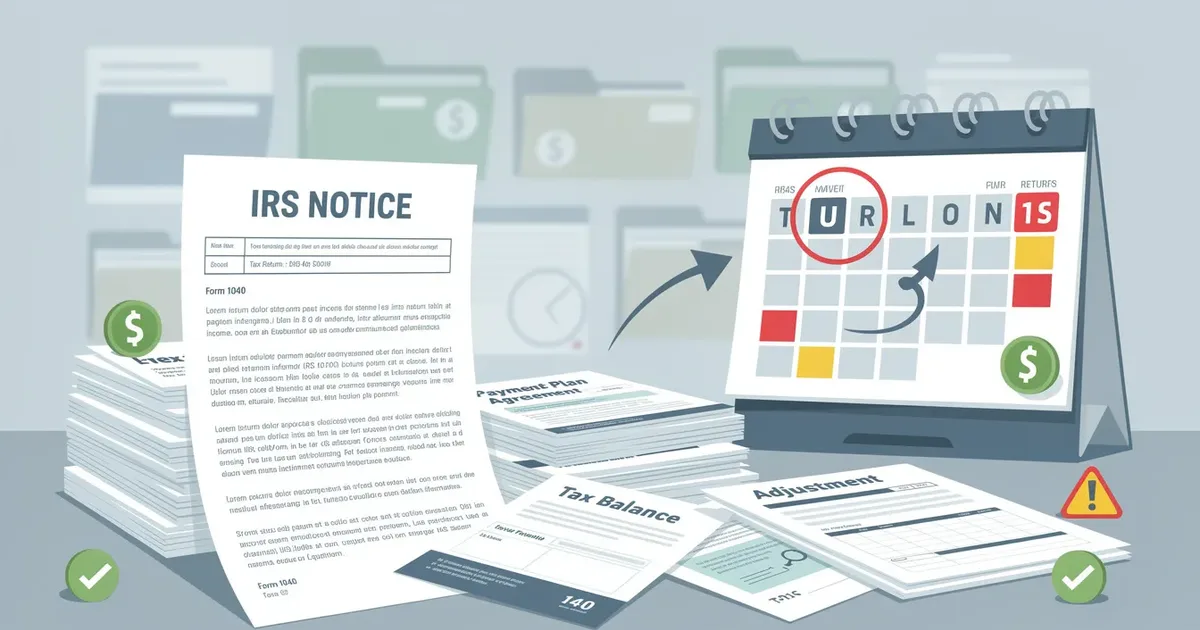
You filed, the refund tracker said "approved," and then instead of a deposit came this letter. The CP49 is the IRS closing a circle: it owed you money for this year, you owed it money from another year, and it did what any creditor with legal authority would do, netted the two. As far as IRS letters go, it's honest and final: no deadline, no threat, just an accounting of where the money went. But "informational" doesn't mean "nothing to do." Offsets hit wrong debts, absorb spouses' refunds they shouldn't, and cross in the mail with payments, and each of those has a fix worth knowing before you shrug and move on.
What is a CP49 notice?
A CP49 tells you the IRS used all or part of your refund to pay a tax debt on your own account, typically an unpaid balance from a prior year, with its accumulated penalties and interest. The notice identifies the year and amount of the debt that absorbed the refund, how much was applied, and what remains on either side: a leftover refund headed your way (typically within about 3 weeks, if no other debts intervene), or a leftover balance still due on the old year.
One scope clarification saves a lot of confused phone calls: the CP49 covers offsets tofederal tax debts, by the IRS. If your refund went to child support, federal student loans, state income tax or unemployment-compensation debts, that's theTreasury Offset Program, run by the Bureau of the Fiscal Service, announced by a different letter, and disputed with the agency that claimed the debt, not the IRS. Match your letter to your situation before deciding whom to call.
Why you received it
- An old balance was sitting on your account.The routine case: a prior year's debt, perhaps one riding the collection sequence throughannual reminders, met a fresh refund, and the system applied one to the other automatically.
- A debt you'd forgotten or thought resolved. Old assessed balances survive quiet years. The CP49 is sometimes how people learn a years-old issue never actually closed.
- A joint refund met one spouse's separate debt. Marry someone with a pre-existing tax balance, file jointly, and the joint refund is exposed to it, the scenario injured spouse relief exists for.
- Your payment and the offset crossed. If you paid the old balance or set up arrangements within the ~21 days before the notice, the offset may have fired before your payment posted, a timing collision the IRS specifically invites you to call about.
- The debt itself is disputed. If the absorbed balance traces to something you contest, a substitute return, an unanswered proposal, the offset inherits that dispute.
How to read your CP49
THE TREASURY
Then verify the debt itself. Pull the old year's account transcript: when was the balance assessed, from what (a filed return, an audit, a substitute return?), and did every payment you made post to it? An offset against a valid debt is annoying but correct; an offset against an inflated or already-paid balance is money to recover, and old debts are exactly where misapplied payments and contestable assessments hide.
Want the offset audited before you accept it?
Upload your CP49 and get a free breakdown of which debt took the refund, whether it holds up, and whether injured spouse relief applies to your filing.
Injured spouse relief: recovering your share of a joint refund
If you filed jointly and the offset paid a debt that is solely your spouse's, their tax balance from before the marriage, their separate-filing years, you may be an"injured spouse," and your portion of the joint refund can come back.
The mechanism is Form 8379, Injured Spouse Allocation. It divides the joint return between the two of you: your income against theirs, your withholding and estimated payments against theirs, credits allocated by whose circumstances earned them. The IRS recomputes what share of the refund is attributable to you, and refunds that share, leaving only your spouse's portion applied to their debt. You can file the 8379 with a joint return preventively (if you know the debt exists) or after an offset like this one, on its own. Processing takes a couple of months; the recovered share is worth it whenever your income and withholding drove the refund.
Your options
What to do, step by step
Identify the debt and check its pedigree
Old year's transcript: assessment source, amount history, payments posted. Five minutes that separates "fair enough" from "wait a minute."
Check for the timing collision
Paid or arranged that balance within the last three weeks? Call the number on the notice with your confirmation, crossed payments are exactly what that invitation is for.
Run the injured-spouse test
Joint return + spouse's separate debt + your income and withholding in the refund = file Form 8379. Attach W-2s and 1099s as instructed; expect processing measured in weeks.
Track the remainder if one is due
Partial offsets promise the difference within about 3 weeks. Quiet past that: check your online account for further offsets, then call.
Deal with what's still owed
A surviving balance keeps accruing and keeps future refunds exposed. Plan, hardship delay, or OIC, pick one and close the loop.
Adjust the coming year
If yearly refunds keep feeding an old debt, consider whether withholding should shrink (money in your paycheck instead of the offset pipeline) while the balance gets its own arrangement.
Common mistakes with a CP49
- Treating it as theft instead of accounting, the refund paid your own debt; the productive energy goes into verifying the debt, not mourning the deposit.
- Not verifying an old, half-remembered balance, stale debts carry the highest rates of misapplied payments and contestable assessments.
- Missing the injured-spouse recovery, Form 8379 is unknown to most filers, and unclaimed shares are simply lost.
- Confusing IRS offsets with Treasury offsets, child support and student loan interceptions are disputed with the claiming agency; calling the IRS about them wastes weeks.
- Ignoring the surviving balance, an offset that didn't clear the debt leaves the collection sequence alive and next year's refund on the menu.
CP49, Frequently asked questions
What is a CP49 notice?
Will I get any of my refund after a CP49?
What is injured spouse relief and does it apply to my CP49?
What if I already paid the debt the CP49 mentions?
Is a CP49 the same as an offset for child support or student loans?
What should I do if a balance remains after the offset?
Related notices
Browse the complete directory of IRS notices orlook up any notice number.