
IRS Underpayment Penalties: How They Work and How to Avoid Them

The U.S. operates on a pay-as-you-go system, which means the IRS expects you to pay taxes throughout the year, not just when you file your tax return in April. If you don't pay enough along the way, you could face an IRS underpayment penalty, even if you settle up in full by the filing deadline. This guide breaks down how the penalty works, who it affects, and what you can do to avoid it.
Key takeaways about IRS underpayment penalties
An IRS underpayment penalty applies when you owe $1,000 or more in tax after subtracting withholding and refundable credits, and you haven't paid enough tax during the year through estimated payments or paycheck withholding. Here's a summary of what you need to know:
The IRS uses a pay-as-you-go system. A penalty may apply if total tax due is $1,000 or more after subtracting credits and withholdings, regardless of whether you pay the balance by April.
Safe harbor rules let you avoid a penalty by paying at least 90% of your current-year tax, or 100% of your prior year's tax (110% if your adjusted gross income exceeded $150,000).
The penalty is calculated quarterly using an interest rate tied to the federal short-term rate plus 3 percentage points - around 7% annually as of mid-2026.
Estimated taxes and withholding adjustments are your two main tools for staying current with the IRS throughout the year.
You can reduce or sometimes eliminate the penalty by using the annualized income method, increasing withholding mid-year, or qualifying for a waiver due to unusual circumstances.
Most taxpayers first learn they owe a penalty after receiving an IRS notice. ClearNotice can help you decode that letter in plain English so you understand what's owed, what deadlines apply, and what your options are.
What is an IRS underpayment penalty?
An underpayment penalty applies when you don't pay enough income tax throughout the year via withholding and estimated tax payments. This isn't only about being late at filing time. The IRS expects regular payments as you receive income, and the IRS imposes the underpayment penalty when those payments fall short during the year.
On your tax return, this penalty often appears as "Estimated tax penalty" or "Underpayment of estimated tax." It's computed on IRS Form 2210 for individuals, estates, and trusts. You may have to pay a penalty if you underpay estimated taxes relative to what the IRS requires for each payment period.
This is separate from both the failure-to-file penalty (charged when your return is late) and the failure to pay penalty (charged when tax owed remains unpaid after the due date). Those penalties have different rates and rules.
Who gets hit? Employees whose income tax withheld is too low, self-employed workers, gig workers, investors with dividends or capital gains, anyone with a second job, and retirees whose pension or social security withholding doesn't cover their full tax liability. Even someone with a W-2 can owe if withholding doesn't keep pace with actual income throughout the taxable year.
How IRS underpayment penalties are calculated
The IRS calculate the estimated tax penalty period by period, not as a single lump sum. For each quarter, they compare the required payment amount to what you actually paid through withholding and estimated payments by that quarter's due date. Any shortfall gets charged interest for the number of days it remained unpaid.
The penalty is calculated based on the tax owed each quarter. For individuals, the interest rate equals the federal short-term rate plus 3 percentage points, and it's adjusted every quarter. For example, the underpayment penalty interest rate is 7% for July–September 2026. The IRS charges penalties for late estimated tax payments using this rate, compounded daily.
The inputs are straightforward: to determine the amount owed, the IRS starts with your total tax on Form 1040, subtracts refundable credits and all income tax withheld, and then compares the remaining required amount against your estimated payments. Under the regular method, each quarter's required payment is roughly 25% of the annual required amount.
Most tax software handles this calculation automatically, but if you have uneven income, Form 2210 lets you use the annualized income installment method to potentially reduce the penalty.
In short: Penalty = Underpaid amount × IRS quarterly interest rate × days unpaid.
IRS safe harbor rules to avoid a penalty
Safe harbor is the simplest way to avoid an estimated tax penalty, even if your final tax bill turns out to be large. Taxpayers can avoid penalties by meeting safe harbor thresholds for estimated tax payments.
The main IRS safe harbor rules work like this:
Pay at least 90% of your current-year income tax liability through withholding plus estimated payments, or
Pay 100% of the tax shown on your prior year tax return if your adjusted gross income was under $150,000 ($75,000 if married filing separately)
You must pay 110% of last year's tax if your AGI exceeds $150,000
No penalty applies if, after subtracting withholding and refundable credits, you owe less than $1,000 when you file.
Meeting a safe harbor early in the year protects you from the underpayment penalty even if your income grows substantially by December. For planning 2026 estimated taxes, using your 2025 income tax liability from your prior year tax return as a benchmark is often the most practical approach, especially when current-year income is hard to predict.
High-income taxpayers should double-check the 110% rule. If your adjusted gross income from the preceding tax year was above $150,000, the standard 100% of the tax safe harbor won't protect you.

Estimated tax payments: who must pay and when
Estimated tax payments are quarterly payments of income tax, self-employment tax, and sometimes other taxes when withholding alone isn't enough. Quarterly estimated tax payments are required for non-wage income like self-employment or investments.
You typically need to pay estimated taxes if you:
Are self-employed, a freelancer, or an independent contractor
Earn significant interest, dividends, or capital gains
Own rental property generating taxable income
Receive IRA, pension, or social security distributions without adequate tax withheld
Have a second job or other income sources lacking withholding
Generally, you must make estimated payments if you expect to owe at least $1,000 in tax after withholding and credits, and your withholding won't satisfy a safe harbor threshold.
The standard due dates for a tax year are:
Quarter | Due Date |
|---|---|
Q1 | April 15 |
Q2 | June 15 |
Q3 | September 15 |
Q4 | January 15 (following year) |
If any of these dates fall on a weekend or legal holiday, the due date shifts to the next business day. Taxpayers use Form 1040-ES and its worksheet to calculate estimated tax, and payments can be submitted via IRS Direct Pay, EFTPS, or the IRS2Go app.
A practical example: a gig worker with no employer withholding earns $60,000 in self-employment income. They'd calculate their expected tax liability (including self-employment tax), divide it into quarterly payments, and submit each one by the due date to avoid a penalty.
How to avoid or reduce an estimated tax penalty
You can avoid penalties both by planning ahead and by correcting course mid-year if your income changes. Taxpayers should monitor their tax situations regularly and adjust payments as needed.
Adjust your W-4 withholdings to cover tax liabilities accurately. You can have more income tax withheld from each paycheck by entering an additional flat dollar amount on Form W-4, which your employer will apply each pay period.
If you're retired, request higher withholding on social security, pension, or IRA distributions instead of relying entirely on estimated payments.
Use the IRS Tax Withholding Estimator and your prior-year return to project whether your current combination of tax withheld and estimated payments will meet the 90% current-year or 100%/110% previous year threshold.
Making a larger estimated tax payment later in the year can still reduce the overall penalty. Since the IRS calculates underpayments for each period separately, a catch-up payment lowers the number of days your balance was underpaid.
If you have irregular income - say a large bonus or stock sale late in the year - using the annualized income method on Form 2210 can cut the penalty by matching required installments more closely to when you actually receive income.
Taxpayers can adjust paycheck withholding to cover potential tax shortfalls at any point during the year.
Exceptions and penalty waivers
Even when you don't meet safe harbor rules, the IRS may waive or reduce the estimated tax penalty in special situations. The IRS may waive penalties for unforeseen circumstances where imposing the penalty would be inequitable.
Common exceptions include:
Disability can qualify for waiving underpayment penalties, especially if it occurred during the tax year
Retirement after age 62 may allow penalty waivers if the underpayment was due to reasonable cause and not willful neglect
A casualty event, such as a house fire or a local disaster, or other unusual circumstance that prevented timely payments
A family member's death or serious illness during the year
Reliance on incorrect written IRS advice
Farmers and fishermen have special rules: farmers can avoid penalties by paying taxes by March 1 of the following year and filing their return by that date, or by making a single estimated payment by January 15.
Taxpayers typically use Form 2210 to request a waiver, sometimes with a written statement attached to their return. Documentation - hospital records, disaster declarations, IRS correspondence - strengthens any penalty relief request.
How underpayment penalties relate to other IRS penalties
Underpayment penalties are only one category of IRS penalty, and they often appear alongside others on the same account.
The failure-to-file penalty is generally 5% of unpaid tax per month (or part of a month), up to 25%, starting after the filing deadline.
The failure to pay penalty is typically 0.5% per month of unpaid tax, up to 25%, beginning the day after the April due date. The underpayment penalty is 0.5% per month unpaid on the outstanding balance.
The IRS charges interest on penalties starting from the due date, and interest compounds daily, increasing the total cost over time.
A taxpayer can be charged both an estimated tax underpayment penalty (for not paying enough during the year) and a failure to pay penalty (for still owing tax after the April deadline). Interest accrues on unpaid tax and on some penalties until the full balance is paid.
Paying as much as possible as early as possible - even before setting up a payment plan - helps limit both penalties and interest.

What happens when the IRS charges an underpayment penalty
Taxpayers usually first see the penalty either on their filed return (if tax software computed it) or in an IRS notice. The notice states the underpayment penalty amount, the tax year involved, how the IRS calculated it, and any additional interest being added.
When you receive this notice, carefully review the figures. Confirm your income, withholding, and estimated payments for each quarter and compare them to what the IRS shows. Errors happen - a missing payment or misapplied credit can inflate the penalty.
If you believe the penalty is incorrect, respond in writing or by phone using the contact information and deadline printed on the notice. Attach proof of payments, bank statements, or corrected forms. If your notice was sent from the IRS Holtsville NY office or another processing center, the letter will include specific instructions for your response.
Paying the assessed penalty promptly stops more interest from building on that amount, even though tax owed and other penalties may still accrue separately.
Getting help: payment plans, penalty abatement, and ClearNotice
Underpayment penalties are common, and there are structured ways to manage or reduce them.
If you can't pay your full tax bill and penalty amount immediately, you can apply for an IRS payment plan (installment agreement) online or by mail. This lets you pay over time and may reduce some future penalties while you pay down the balance.
In some situations, you can request penalty abatement. First-time abatement is available for taxpayers with a clean compliance history. Reasonable cause relief applies for serious illness, disasters, or other hardships. Disputes based on incorrect written IRS advice require a signed statement and copies of the original correspondence - all signed under penalty of perjury.
ClearNotice fits in here: you can upload the exact IRS notice about your estimated tax penalty and receive a clear breakdown of what it means, what deadlines apply, and your action steps - whether that's paying, disputing, requesting relief, or setting up a plan.
This page was last reviewed or updated October 2026. Tax law changes frequently, so always verify current rates and thresholds with the IRS.
The best time to adjust your withholding or estimated taxes for the current year is right now. Don't wait for next April to discover you owe a penalty again. Use ClearNotice to understand your IRS notice, then take action before the next quarterly deadline.
Keep reading
 Penalties & abatement
IRS Insufficient Funds Penalty: What to Do Next: IRS Guide
If your IRS payment bounced, a dishonored payment penalty may already be on your account. This guide explains how the IRS insufficient funds penalty works and what to do fast.
 Penalties & abatement
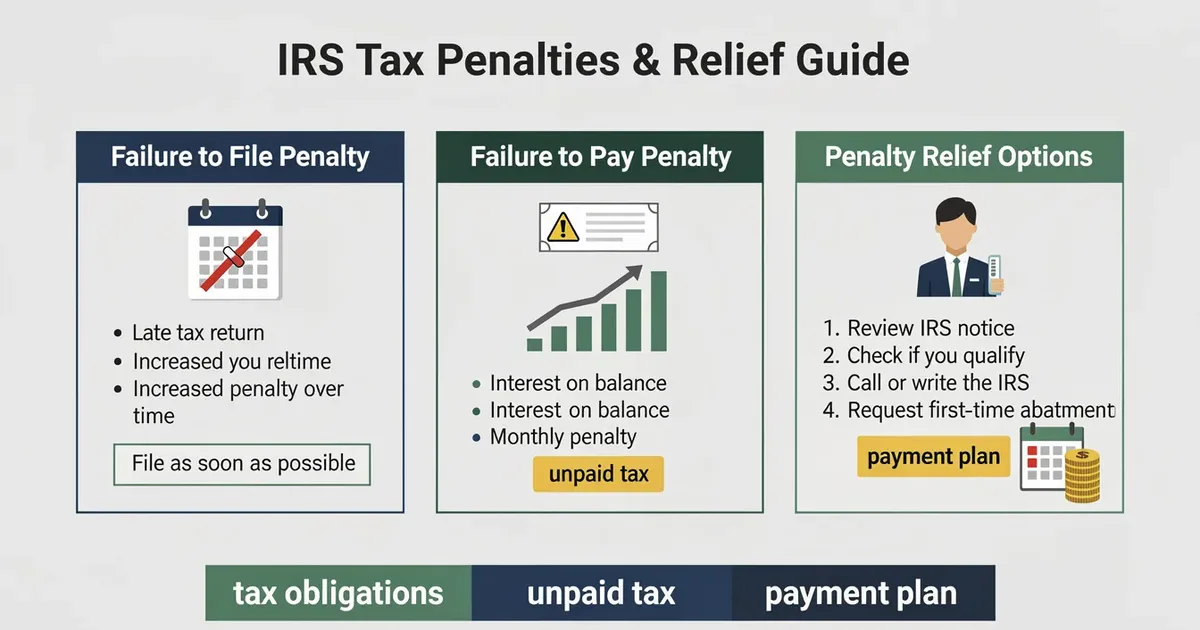
Penalties for IRS: Failure to File, Pay & Penalty Relief
Received an IRS notice about a penalty? This guide breaks down the most common IRS penalties in plain English, including how they are calculated and your options for relief.
 Penalties & abatement
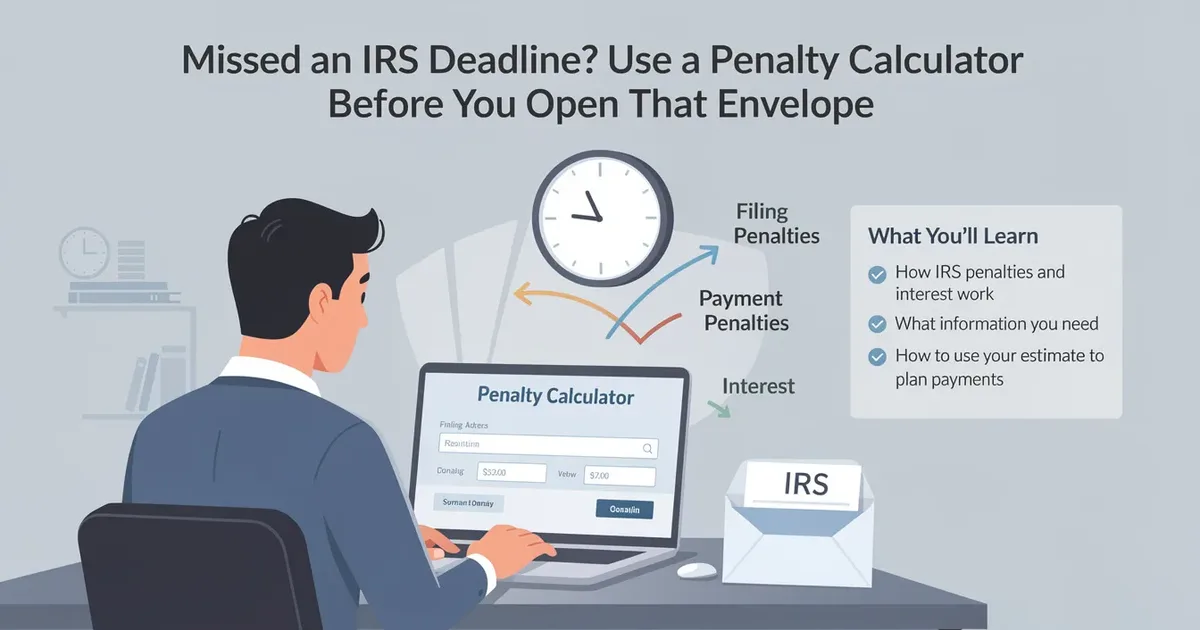
Penalty Calculator IRS: Estimate What You Owe: IRS Guide
Missed an IRS deadline? An IRS penalty calculator helps you estimate late filing and payment penalties before your notice arrives, so you can make smarter payment decisions.