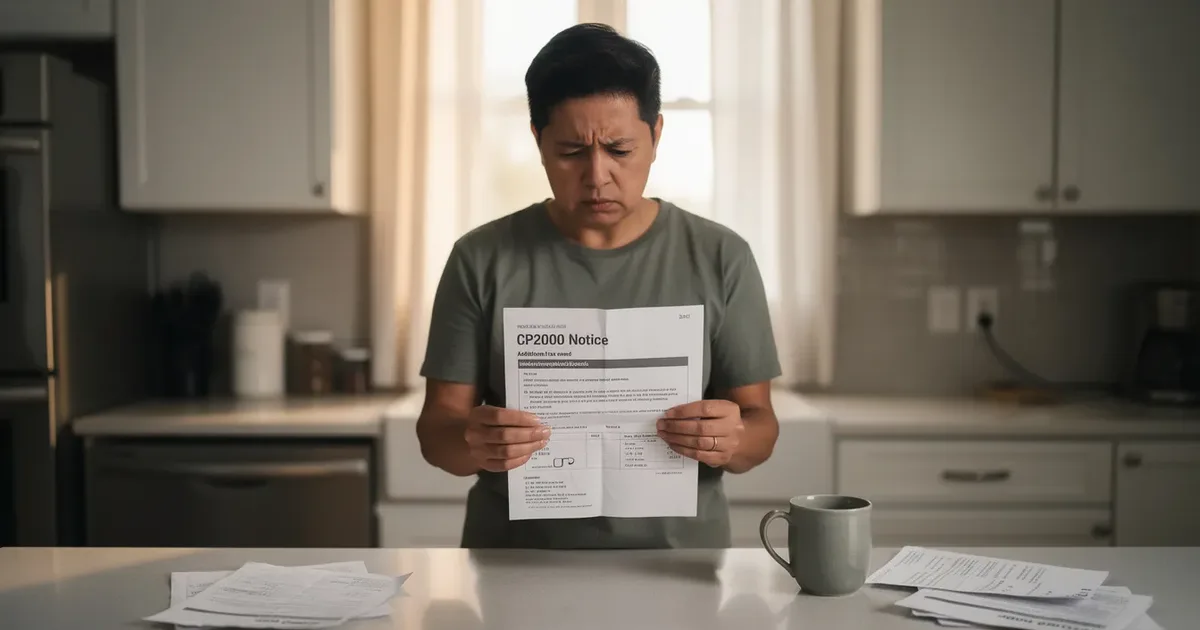
Every year, the IRS mails millions of CP2000 notices through its Automated Underreporter (AUR) program. A computer, not a person, compared your tax return against the W-2s, 1099s and other information documents filed under your Social Security number, found a difference, and generated a proposed recalculation of your tax. If you just opened one and your stomach dropped at the "proposed amount due," take a breath: this is the single most disputed IRS notice, and thousands of taxpayers reduce or eliminate the proposed amount every month simply by responding correctly and on time.
What is a CP2000 notice?
A CP2000 is officially a "Notice of Proposed Adjustment for Underpayment/Overpayment."The key word is proposed. The IRS is saying: "Based on documents third parties sent us, we think your return missed some income (or overstated withholding), and if we're right, here's the additional tax, penalties and interest that would result." Nothing has been assessed yet. You are not being billed. You are being asked to confirm, correct, or contest the computer's math.
This matters because the computer's math is often incomplete. The AUR system sees grossamounts: the full proceeds of your stock sales, the full total on a 1099-K, the entire distribution from a retirement account. It doesn't automatically know your cost basis, your business expenses, the portion that was a non-taxable rollover, or that the "missing" income was actually reported on a different line of your return. Your response is precisely where that context gets added, and where proposed amounts collapse.
Why you received it: the most common triggers
In practice, the vast majority of CP2000 notices come from a handful of situations:
- Stock or crypto sales (1099-B): the broker reported gross proceeds, and the IRS assumed a cost basis of zero, taxing you on the entire sale instead of your actual gain. This is the classic case where a $6,000 proposal turns into a $300 reality.
- Gig and freelance income (1099-NEC, 1099-K):a client or platform reported payments you forgot, or payments you did report but on a line the computer didn't match, and it knows nothing about your deductible expenses.
- Retirement distributions (1099-R): a 401(k) or IRA withdrawal that was rolled over (non-taxable) but flagged as income.
- A forgotten form:a small savings-account 1099-INT, a second job's W-2, gambling winnings on a W-2G, or unemployment income on a 1099-G that simply never made it onto the return.
- Identity issues:income reported under your SSN that isn't yours at all, a sign of employment-related identity theft that needs its own response.
Your notice lists each item in a section comparing "shown on return" versus "reported to IRS by others," with the payer's name. Matching each line against your own records is the foundation of your response.
How to read your CP2000
The notice is long, often 6 to 12 pages, but only a few elements drive everything:
THE TREASURY
Deeper in the notice you'll find the item-by-item comparison table, the IRS's recalculation (including any proposed 20% accuracy-related penalty and interest), and theresponse form, the page where you check whether you agree, partially agree, or disagree. That response form, not a letter alone, is what the AUR unit processes first.
Want this done for your actual notice?
Upload your CP2000 and get a free plain-English breakdown of every line, with your items, your amounts and your exact deadline.
Your deadline, and what happens if you ignore it
You typically have 30 days from the date on the notice(60 days if you're outside the U.S.) to respond. The exact date is printed on your letter and it governs, not the day you opened the envelope. If you need more time to gather documents, call the number on the noticebefore the deadline; the IRS routinely grants extensions on CP2000 responses when asked.
Silence, on the other hand, is expensive. If you don't respond, the IRS follows a predictable escalation: it issues a CP3219A Statutory Notice of Deficiency, which opens a strict 90-day window to petition Tax Court, a deadline that cannot be extended for any reason. After those 90 days, the proposed tax is assessed: it becomes a real debt, penalties and interest are locked in, and you'll start receiving the collection sequence (CP14, then reminders, then levy warnings). Everything is harder and more expensive at that stage than a simple response is today.
Your three response options
Every CP2000 response comes down to one of three positions, marked on the response form:
Choosing the right position, and matching each contested line with the right document, is where most of the money is won or lost. A vague "I disagree" without documentation usually produces a recomputed notice with the same amount; a precise, evidence-backed response usually produces a reduction or a no-change letter (CP2005).
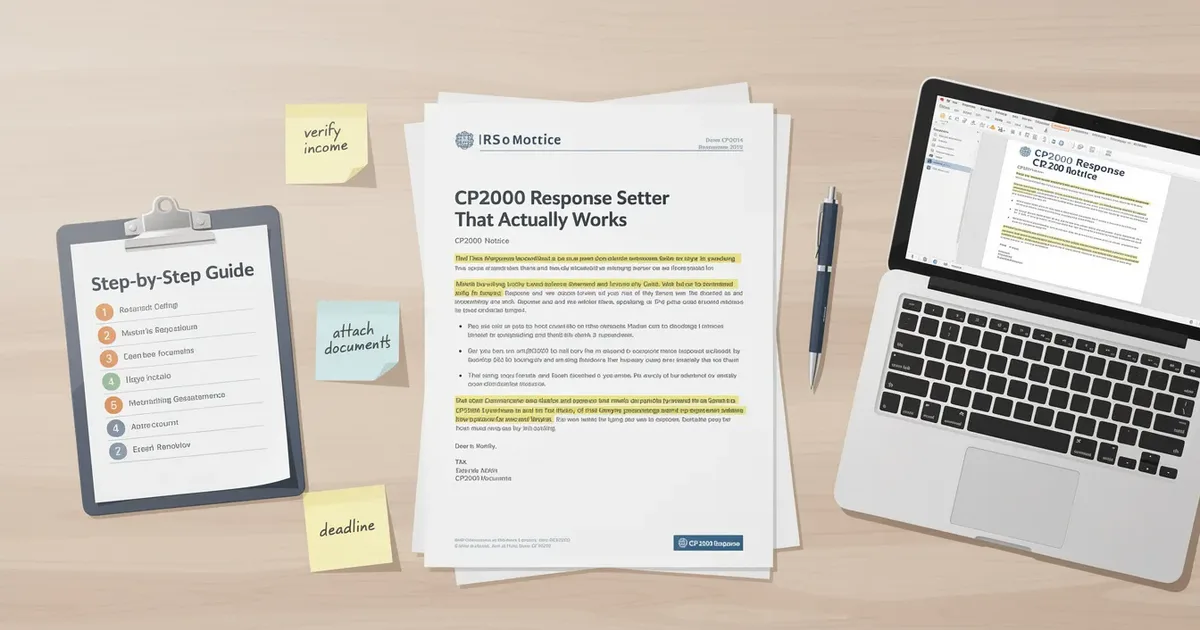
How to respond, step by step
Match every line against your records
For each item in the comparison table, pull the source: your brokerage 1099-B with cost basis, your bank statements, your own return. Mark each item "agree" or "dispute" with a one-line reason.
Complete the response form
Check the box matching your position (agree / partial / disagree). For partial or full disagreement, write a short, factual explanation per item, dates, amounts, form names. No essays needed.
Attach your evidence
Copies only, never originals: corrected 1099s, brokerage statements showing basis, proof a rollover occurred, the schedule where the income was already reported. Label each attachment to the item it supports.
Send it the right way, before the deadline
Use the fax number or mailing address on your notice, or the IRS Document Upload Tool if your letter offers it (fastest). If mailing, use certified mail so you can prove the date.
Calendar the follow-up
The IRS typically answers a CP2000 response in 60-90 days. You'll receive either a no-change letter, a reduced recomputation, or a request for more information. Don't panic if an interim "we need more time" letter arrives first.
Can the amount be reduced? (Very often, yes)
Three levers reduce CP2000 proposals every day:
1. Missing cost basis.The single biggest one. If the computer taxed gross proceeds of a stock or crypto sale, documenting your purchase price converts "all of it is income" into "only the gain is income", routinely cutting proposals by 80-95%.
2. Already-reported or non-taxable income.Income reported on a different line (business income on Schedule C that the computer matched against the wrong box), rollovers, inherited amounts, or income that simply isn't yours.
3. The accuracy penalty. Even when tax is genuinely due, the proposed 20% accuracy-related penalty can be contested separately with a reasonable cause explanation, for example, you never received the 1099 because the payer sent it to an old address. Removing the penalty alone can save hundreds.
Five mistakes that make a CP2000 worse
- Ignoring it, the proposal becomes an assessment via the CP3219A, with penalties locked in.
- Paying immediately out of fear, before checking whether the amount is even correct. Once you agree, reversing is much harder.
- Filing a 1040-X instead of responding, which confuses the AUR process and doesn't stop the clock.
- Responding without documents, an unsupported "I disagree" is treated as no defense.
- Missing the deadline while gathering papers, call for an extension instead; the request itself takes five minutes.
CP2000 vs. an audit: know the difference
A CP2000 is document matching by computer; an audit is a human examination of your return. The distinction has practical consequences: a CP2000 is limited to the listed items (an auditor can expand scope), it's resolved entirely by mail through the AUR unit, and it doesn't mark your account as "examined." Responding to a CP2000 with clear documentation almost never "triggers" an audit, the far riskier move is ignoring it. If your letter is actually aLetter 566 or CP75, you're in examination territory and the playbook differs.
CP2000, Frequently asked questions
Is a CP2000 a bill?
How long do I have to respond?
What happens if I ignore it?
Should I file an amended return?
Can I set up a payment plan if I agree?
Will responding trigger an audit?
Related notices
Browse the complete directory of IRS notices orlook up any notice number.