
IRS Insufficient Funds Penalty: Dishonored Checks, Returned Payments, and How to Fix Them Fast

If your IRS payment just bounced, you're not alone, and you're not stuck. The IRS insufficient funds penalty—also called a dishonored payment penalty—applies when a payment to the IRS is returned unpaid, adding a penalty to your balance and often more interest and other penalties if you do nothing.
If you received a confusing IRS notice about a bounced check, failed debit, or other rejected payment, this quick guide explains what triggered it, how the penalty is calculated, what to do next, when you may be able to ask for penalty relief, and how it can overlap with other IRS penalties. Acting fast matters because a returned payment can grow your tax debt quickly, and ClearNotice helps translate IRS letters into plain English so you can understand the deadline and respond with less guesswork.
Quick answer: What happens if your IRS payment bounces?
When a tax payment is returned unpaid due to insufficient funds, the IRS imposes a dishonored check or other form of payment penalty on top of the original tax you owe. In plain English, this can happen when a payment bounces like a bad check. This penalty exists under Internal Revenue Code Section 6657, and it hits your account whether the failed payment was a paper check, an electronic payment, or an EFTPS debit.
The IRS does not resubmit a returned payment for collection. Once your bank dishonored that draft, the IRS treats it as if the payment was never made. You must make a new payment arrangement on your own.
Here's the core rule:
For dishonored payments of $1,250 or more, the penalty is 2% of the payment amount.
For payments under $1,250, the penalty is $25 or the payment amount, whichever is less.
Interest begins to accrue on both the unpaid tax and the dishonored check penalty until the full amount is paid.
A dishonored payment does not eliminate the original tax debt and can incur additional penalties or interest.
Example: You schedule a $2,000 tax payment for April 15, 2026. Your bank rejects the debit for insufficient funds. You now owe the $2,000 in tax, a $40 dishonored payment penalty (2% of $2,000), plus failure-to-pay penalties and interest until you pay in full.
If you've received an IRS notice like a CP14, Letter 608C, or CP57 about a dishonored payment, ClearNotice can help you decode what the letter means and what deadlines you're facing.
What is the IRS Dishonored Check or Other Form of Payment Penalty?
This is the IRS insufficient funds penalty, formally called the "Dishonored Check or Other Form of Payment Penalty" under IRC Section 6657. It's triggered when a financial institution doesn't honor a payment you sent to cover your tax bill.
The penalty applies to checks, electronic funds withdrawals, and other payment instruments. Since 2010, the rule explicitly covers electronic payments, not just paper checks and money orders.
This penalty is separate from the failure-to-pay penalty, failure-to-file penalty, and estimated tax penalty. However, they can all stack on the same unpaid balance in the same month.
The IRS generally sends a notice explaining the penalty and amount due if a payment fails. Common notices include:
Letter 608C - dishonored check penalty explained
CP14 - balance due notice
CP57 - bank did not honor a draft on your account
CP 165 - dishonored check penalty notice
Key point: this penalty is about the failed payment itself, not about how much tax you ultimately owe.
How the IRS calculates the dishonored check penalty and interest
The IRS dishonored check penalty is based purely on the value of the payment that failed, not your total tax liability. The IRS charges 2% for dishonored payments over $1,250. For dishonored payments under $1,250, the penalty is $25 or less.
The two-tier formula:
Payment of $1,250 or more: penalty = 2% of that payment amount
Payment under $1,250 but $25 or more: penalty = $25
Payment under $25: penalty = the full payment amount
Here's how that plays out:
A $5,000 electronic debit returned for insufficient funds → $100 penalty
A $400 check bounced → $25 penalty
A $20 money order dishonored → $20 penalty
If multiple estimated tax payments are dishonored during the year, a separate penalty applies to each one. Two bounced $1,500 quarterly payments would result in $30 each, or $60 total.
Interest is charged on both the unpaid tax and any assessed dishonored check penalty from the applicable start date until everything is paid. The IRS also continues charging the standard failure-to-pay penalty (0.5% per month) on the unpaid tax balance, so delaying payment compounds costs quickly.
Why your IRS payment was dishonored (even if you had money in the bank)
Many taxpayers are genuinely surprised to get a dishonored payment notice when they believed they had enough funds in their account to cover the payment. But payments can fail due to insufficient funds, incorrect account details, or bank processing issues.

Common reasons tied to your bank account:
Temporary holds on recent deposits that haven't cleared
Daily debit limits set by your bank
Automated sweeps between linked accounts that moved money before the IRS draft hit
Non-NSF reasons that still trigger the penalty:
Incorrect routing or account numbers
Using a savings account that doesn't accept ACH debits
Closed accounts
A stop payment order placed intentionally or by mistake
From the IRS's perspective, any payment that is returned unpaid by the financial institution counts as a dishonored check or other form of payment, regardless of the underlying cause.
A bank error, such as a misapplied deposit or erroneous hold, may qualify as reasonable cause to request abatement of the penalty. To support any penalty relief request, obtain your bank statement showing the balance on the date the IRS attempted the debit, copies of any stop-payment instructions, or a letter from the bank explaining the error. Compare dates carefully: when the IRS presented the payment, what your balance actually was, and when any corrections occurred.
It is advisable to verify account balances before scheduling any tax payments to avoid penalties. Keep enough money in your account to cover payments, factoring in pending transactions.
What to do immediately after a payment is returned for insufficient funds
Your first priority is to pay the tax itself as quickly as possible. Every day your balance remains unpaid, failure-to-pay penalties and interest keep growing, and waiting can also trigger additional late payment charges.
Steps to take right now:
Make a new IRS payment. Log into IRS.gov and use Direct Pay, a debit or credit card, or EFTPS. The IRS will not automatically retry the original bank account draft.
Double-check your details. Verify the routing number, account number, and payment date before submitting. A second dishonored payment doubles the penalty problem.
Pay your taxes in full to stop future penalties. If you can't pay the full amount, pay as much as possible now.
Request a payment plan if you can't pay in full. An installment agreement is one of the solutions the IRS offers to resolve the balance, and it can reduce the failure-to-pay penalty rate from 0.5% to 0.25% per month.
Save your confirmation. Keep the confirmation number, date, and amount of the replacement payment for any later penalty dispute.
Watch your mail. When you receive a follow-up notice like Letter 608C or a CP14 bill, upload it to ClearNotice to get a plain-English explanation of what each letter means and what deadlines apply.
How to request removal of the dishonored check penalty
The IRS can reduce or remove the dishonored payment penalty through penalty abatement when the taxpayer acted in good faith and had reasonable cause to believe the payment would be honored.
Reasonable cause in this context often means you had enough funds in your bank account at the time, or that a bank error or processing glitch caused the dishonor. You can request abatement for reasonable cause or bank error.
Here's the typical process:
Wait for the official IRS notice (Letter 608C, CP14, or another balance-due letter listing the penalty).
Send a written statement to request relief to the IRS address shown on the notice, or file Form 843, Claim for Refund and Request for Abatement to request relief. Either approach works; the key is matching the mailing address to the one on your notice.
Include these details in your penalty relief request: name, address, Social Security number or EIN, tax year, notice number, type and payment amount of the dishonored payment, and a letter explaining why the payment was dishonored and why the penalty should be removed.
Attach supporting documentation. A bank statement showing sufficient funds on the date the IRS attempted the debit is essential. Include proof of a bank error or a stop payment order placed for a valid reason.
If you qualify, also reference First Time Penalty Abatement (being replaced by Automatic Exemption from Penalty for returns due January 1, 2027 and later). This applies if you have a clean filing and payment history for the prior three years with no other penalties assessed.
The IRS typically responds to abatement requests in 30 to 60 days. Interest may continue to accrue while your request is pending, so paying the full amount first and then seeking a refund of the penalty is often the smarter move.
ClearNotice can help you interpret the exact language of your penalty section, identify whether the penalty is eligible for relief, and draft a focused explanation tailored to the notice you received.
How dishonored payments interact with other IRS penalties and payment plans
A single dishonored payment can trigger or worsen several charges tied to the same tax year. Here's how they stack:
Dishonored check penalty: about the bad payment itself
Failure-to-pay penalty: 0.5% per month on unpaid tax past the due date (e.g., April 15, 2026 for 2025 tax returns)
Estimated tax penalty: if the bounced payment was a quarterly estimated tax payment, you may face an underpayment penalty for that period
Interest: accrues separately on unpaid tax, the failure-to-pay penalty, and the dishonored payment penalty
Entering into an installment agreement can stop certain collection actions, but it doesn't immediately remove existing penalties. It does help manage cash flow and avoid liens or levies. However, keeping future payments under a payment plan current is critical. Another dishonored payment on an installment agreement draft can cause the plan to default and trigger additional notices.
Snowball scenario: You owe $3,000 on your tax return. Your April payment bounces. You now owe the $3,000, a $60 dishonored check penalty, failure-to-pay penalties growing each month, and interest on all of it. Wait two months and the total damage can exceed $200 beyond the original tax bill. Correcting the problem within days instead of weeks saves real money.
How ClearNotice helps you read, understand, and respond to dishonored payment notices
Getting a letter mentioning "Dishonored Check or Other Form of Payment Penalty" or "insufficient funds" can feel intimidating, especially when the language reads like a legal brief rather than plain English. That's where ClearNotice comes in.
With ClearNotice, you can upload or access your IRS notice and get a clear breakdown: what the letter means, why the payment penalty was assessed, and what deadlines and amounts apply. It also helps you get organized before seeking professional tax advice if needed. The service highlights the tax year involved, the amount of tax due, the dishonored check penalty amount, interest so far, and any referenced forms or phone numbers.
ClearNotice then walks you through next steps: making a replacement payment, deciding whether to request a payment plan, gathering documents for a penalty abatement request, and recognizing when it may be worth speaking with tax attorneys if the facts are disputed or the stakes are high. It translates IRS terminology like "other form of payment," "full amount due," and "payment in good faith" into language anyone can understand.
If you've just received a dishonored check or insufficient funds notice, use ClearNotice before calling the IRS. You'll understand the notice, know what to ask, and respond confidently before your deadline passes. If you need outside help after reviewing the notice, you may choose a free consultation with a qualified professional.
Keep reading
 Penalties & abatement
IRS Underpayment Penalties: What You Need to Know: IRS Guide
The IRS charges underpayment penalties when you don't pay enough tax throughout the year. This plain-English guide explains how the penalty is calculated and how to avoid it.
 Penalties & abatement
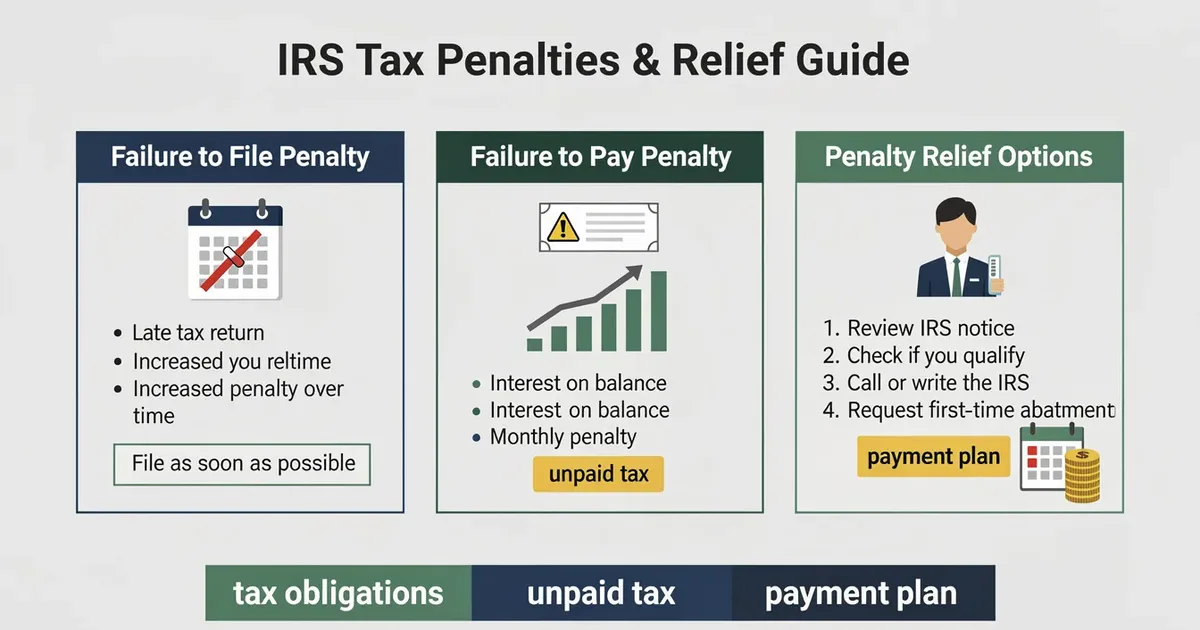
Penalties for IRS: Failure to File, Pay & Penalty Relief
Received an IRS notice about a penalty? This guide breaks down the most common IRS penalties in plain English, including how they are calculated and your options for relief.
 Penalties & abatement
Penalty Calculator IRS: Estimate What You Owe: IRS Guide
Missed an IRS deadline? An IRS penalty calculator helps you estimate late filing and payment penalties before your notice arrives, so you can make smarter payment decisions.