
IRS penalty calculator
An unpaid IRS balance isn't static, it compounds. Enter your numbers and see the penalties and interest stacking on top, plus what three more months of waiting would add.
Part of a month counts as a full month
Set quarterly, check the current rate on irs.gov
Educational estimate, your notice and IRS transcript show the exact assessed figures.
Rough estimate for education only. Actual IRS calculations use daily compounding, quarterly rate changes, payment history and minimum-penalty rules. Your exact figures appear on your notice andIRS transcript. ClearNotice is a document preparation service, not a tax advisor.
The three meters running on an unpaid IRS balance
Failure-to-pay penalty, 0.5% per month.The slow, patient one: half a percent of the unpaid tax for each month (or part of a month), capping at 25% of the balance. It drops to 0.25% per month while an approved installment agreement is active, meaning a payment plan doesn't just stop the collection letters, it literally cuts the penalty rate in half.
Failure-to-file penalty, 5% per month.The brutal one: ten times the pay penalty, capping at 25% in just five months, with a minimum flat penalty once you're more than 60 days late. This asymmetry is the single most useful thing to know about IRS penalties: always file on time, even when you can't pay a cent.Filing stops the 5% meter; only the gentle 0.5% one keeps running. If you've received a CP59 for an unfiled return, this is why acting fast matters so much.
Interest, set quarterly, compounding daily. Interest accrues on the unpaid taxandon the penalties, at the federal short-term rate plus 3 points, recalculated every quarter. Unlike penalties, interest can't be waived on its own, but here's the leverage: when a penalty is removed through abatement, the interest charged on that penalty disappears with it. Between first-time abatement (clean three-year history) and reasonable-cause relief, penalty removal is one of the most underused options in the entire IRS playbook, and asking costs nothing.
Penalty questions, answered
How much is the failure-to-pay penalty?
How much is the failure-to-file penalty?
What interest rate does the IRS charge?
Can penalties be removed?
 Penalties & abatement
IRS Insufficient Funds Penalty: What to Do Next: IRS Guide
If your IRS payment bounced, a dishonored payment penalty may already be on your account. This guide explains how the IRS insufficient funds penalty works and what to do fast.
 Penalties & abatement
IRS Underpayment Penalties: What You Need to Know: IRS Guide
The IRS charges underpayment penalties when you don't pay enough tax throughout the year. This plain-English guide explains how the penalty is calculated and how to avoid it.
 Penalties & abatement
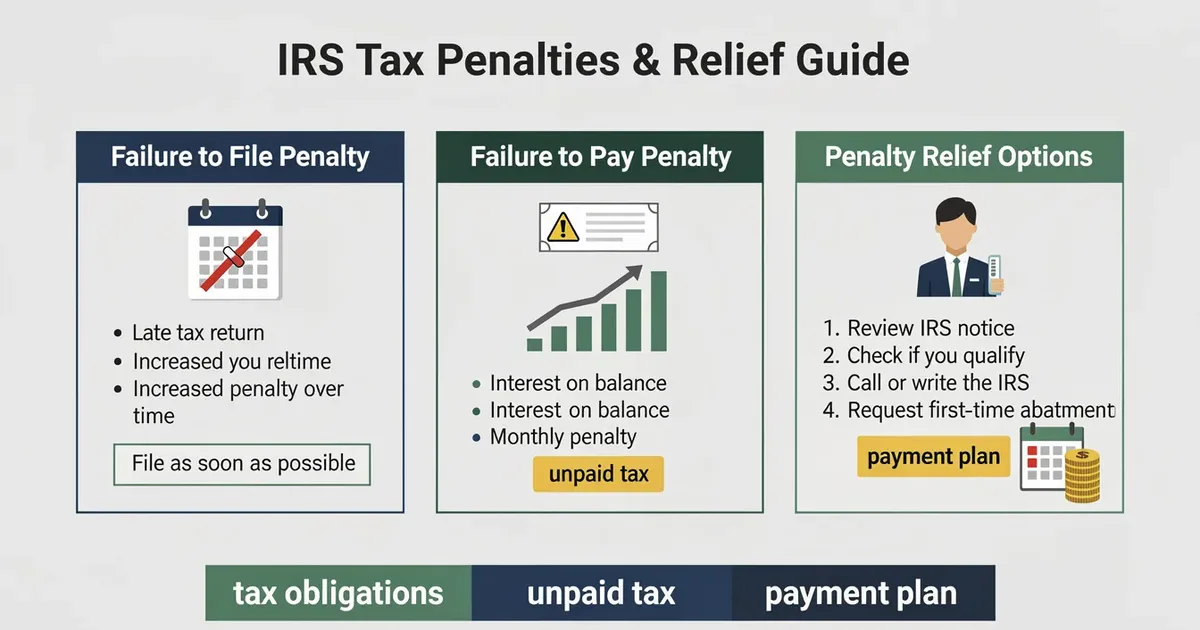
Penalties for IRS: Failure to File, Pay & Penalty Relief
Received an IRS notice about a penalty? This guide breaks down the most common IRS penalties in plain English, including how they are calculated and your options for relief.
The meter is running. Your response stops it.
Upload your notice for the free explanation, including whether penalty abatement looks possible in your case, and the response documents to request it if you want them.
Upload my notice, freeFREE EXPLANATION · ABATEMENT REQUEST INCLUDED IN PACKAGES · $39 ONE-TIME