
IRS penalties per month: how fast do they add up?
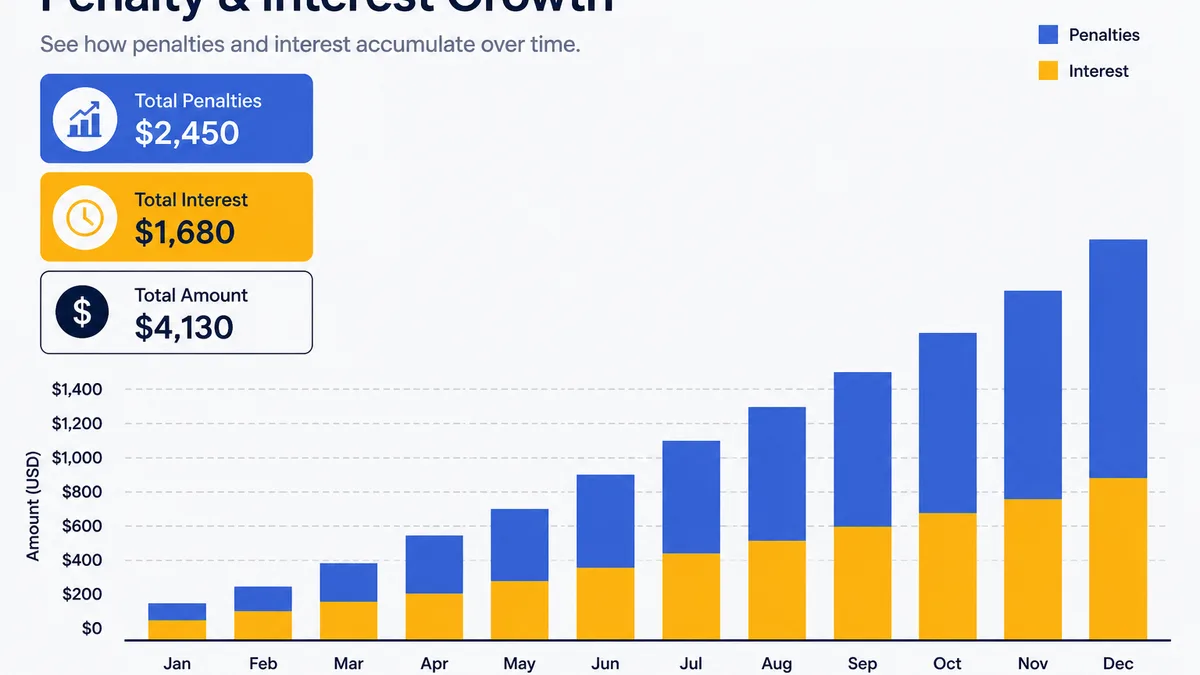
IRS penalties per month do not sit still while you “wait for a better time to pay.” Failure-to-pay charges, failure-to-file charges (if the return is late), and interest can each add to an unpaid balance under different rules. The curve is usually gentle at first on the pay side and much steeper if a return is still missing. Paying down principal, filing, or arranging a formal plan changes the slope.
Three meters, not one blob
When people ask how fast IRS penalties per month and interest add up, they often treat the extra charges as a single fee. On an IRS account they are usually separate lines:
- Failure-to-pay penalty: commonly about 0.5% of unpaid tax per month (or part of a month), with a typical ceiling of 25% of that unpaid tax. The monthly rate can drop while an approved installment agreement is in effect.
- Failure-to-file penalty: commonly about 5% of unpaid tax per month while the return is late, often capping at 25%. This is the steep meter.
- Interest: charged on unpaid amounts under IRS published rates, with its own compounding rules. Rates are not fixed forever, so you should not treat a friend’s old bill as your forecast.
Your notice may show one combined “balance due,” but the pieces still matter when you decide whether to file, pay, or request relief.
A labeled illustration of rate math (not a prediction)
The numbers below are a teaching example only. They show how percentage rules scale on a sample unpaid tax figure. They are not a prediction of your bill, your interest rate, or any notice you received.
Sample facts for the illustration- Unpaid tax used for the example: $4,000
- Assume the return is already filed, so only failure-to-pay is running in this sketch
- Ignore interest for a moment so the penalty math is easy to see
At 0.5% per month on $4,000:
- One month: 0.005 × $4,000 = $20 of failure-to-pay penalty in that month’s rate math
- Three months: about $60 if each month is a full 0.5% on the same unpaid tax figure and nothing is paid
- Twelve months: about $240 of failure-to-pay penalty under the same simplified assumption, still below the 25% ceiling on this sample
Now change one fact: the return is not filed, and the late-filing rate of 5% per month applies to the same $4,000 unpaid tax figure in the illustration.
- One month of late-filing rate math: 0.05 × $4,000 = $200
- Five months at that simplified 5% pace reaches the common 25% area on the sample unpaid tax ($1,000 in this teaching sketch)
Those two sketches explain the growth curve people feel in real life. Pay-side months drip. Missing-return months climb much faster until the late-filing ceiling or until you file.
When both late filing and late payment apply in the same months, IRS coordination rules adjust how the percentages combine. The teaching point remains: an unfiled return is usually the expensive branch.
Interest was left out of the dollar sketch on purpose. Interest uses published rates that change, and it compounds under IRS methods. Adding a made-up interest rate here would pretend precision we do not have for your account. On a real balance, interest sits on top of tax and often on top of certain penalties, which is why the total can feel like it “keeps moving” even in quiet months.
What the growth curve feels like over time
Early months after a filed return with a balance: failure-to-pay adds in relatively small monthly bites on the unpaid tax, and interest adds under current rates. A CP14 or similar balance letter may be your first clear view of the split. If you ignore the balance: later collection letters can escalate. The monthly percentages do not need drama to keep working. They just keep applying under the rules until the unpaid tax shrinks, a ceiling is hit, or relief removes a penalty. If the return is still missing: the late-filing meter dominates the early story. Filing flattens that steep part. After filing, the story shifts to pay-side penalty and interest on whatever remains unpaid. If you pay principal: you shrink the base those percentages use. Partial payments matter. Waiting for a perfect lump sum while the base stays large is often more expensive than paying what you can and planning the rest.What actually slows the climb
Practical moves that change the slope:
- File any missing return so late-filing growth stops
- Pay as much unpaid tax as you can to shrink the base
- Set up an installment agreement when you need time; ask how the failure-to-pay rate works during the plan
- Request penalty relief only when first-time abatement or reasonable cause facts truly fit
- Estimate pieces with the penalty calculator so you are reacting to structure, not panic
A payment plan is not forgiveness. It is a schedule. Interest can continue. Some penalty rules change during an agreement; others do not. Read what the IRS confirms for your plan type.
How to read a balance notice without guessing
On letters such as CP14, separate:
- Tax
- Penalties (and which kind, if shown)
- Interest
- Payments or credits already applied
- The response or payment date printed on the page
If you paid recently, posting lag can make a letter look worse than the live account. Keep proof and check your online account or a later transcript before assuming the notice is wrong forever.
Why “I’ll deal with it next year” is expensive thinking
IRS penalties per month are patient. They do not need you to open the envelope to keep accruing under the rules. Next year’s refund can also be applied to this year’s unpaid balance. The growth curve is not only about new letters. It is about the unpaid tax base sitting there while percentages and interest keep working.
Collection can intensify while monthly charges continue. If a later notice warns about levy action or a final collection step, treat that date as real. Setting up payment or calling the number on the letter beats hoping the balance will freeze on its own.
A simple way to brief yourself or a pro
Write four lines:
- Tax years with unpaid balances
- Whether each year’s return is filed
- Current unpaid tax (not just the grand total)
- Whether you are in a plan, requesting relief, or still deciding
Those four lines let the penalty calculator and a licensed professional focus on rate structure instead of reconstructing your story from memory.
Bottom line on speed
IRS penalties per month add up through separate rules: a relatively small failure-to-pay percentage, a much larger failure-to-file percentage while a return is late, and interest under published rates. The teaching sketch on a $4,000 unpaid tax figure shows why missing returns feel sudden and why filed balances still grow if left alone. Flatten the steep part by filing. Shrink the base by paying. Use plans and relief tools when they fit. For a structured estimate, start with your notice (often a CP14) and the penalty calculator, then confirm details against your transcripts.
Quick follow-ups
Do penalties and interest use the same monthly rate?
No. Failure-to-pay and failure-to-file penalties use their own percentage rules. Interest follows IRS published rates and compounding rules, which change over time.
Does a payment plan stop all growth?
A plan organizes repayment and can reduce the failure-to-pay rate while the agreement is in effect, but interest can still accrue. Always read the terms that apply to your agreement.
Where do I see the monthly build on my account?
Balance notices and account transcripts break out tax, penalties, and interest. A first balance letter is often a CP14.
Upload a photo for a free plain-English explanation of your amounts, deadline, and options.

Founder of ClearNotice · Updated August 2026 · About