The CP14 is the most-mailed notice in the entire IRS system, tens of millions go out every year, with a heavy wave in late May and June after filing season. If one just landed in your mailbox, you're at the very beginning of the IRS collection process, which is genuinely good news: this is the stage where every option is still open, penalties are smallest, and a single well-chosen response, payment, payment plan, dispute, or abatement request, usually ends the matter before any of the harsher letters exist.
What is a CP14 notice?
A CP14 is a balance due notice, the IRS's first formal statement that its records show you owe tax that hasn't been paid. Unlike a CP2000, which merelyproposes a change, the amount on a CP14 has already been assessed: it's on your account as a real debt. Most of the time it's simply the balance from the return you filed, meaning you reported the tax yourself but the payment didn't arrive, didn't clear, or didn't cover the total once penalties and interest were added.
"Assessed" doesn't mean "correct," though. CP14 notices are notorious for going out while a payment is still being processed, for missing an estimated payment that was applied to the wrong year, and for penalty calculations that assume facts that aren't true in your case. So the first move is never to pay in a panic, it's to check the math against your own records, which takes about ten minutes.
Why you received it: the usual causes
Nearly every CP14 traces back to one of these situations:
- You filed with a balance you couldn't fully pay. The return was accepted, the unpaid portion was assessed, and the CP14 is the bill for it, plus a failure-to-pay penalty and interest calculated from the original due date.
- Your payment and the notice crossed paths.You paid, by check, Direct Pay, or through your tax software, but the payment hadn't posted when the notice was generated. This is extremely common in May and June.
- A payment was misapplied.An estimated payment credited to the wrong tax year, a payment posted to a spouse's account after a filing-status change, or a check applied to the wrong period. The money exists; the account just doesn't show it where it should.
- Withholding or estimated payments fell short.The return was right, but what was paid in during the year didn't cover the tax, often after a side income year, an early retirement withdrawal, or a W-4 that was never updated.
- Penalties and interest on an old adjustment. A prior correction (say, an agreed CP2000 or a math-error change like aCP11) left a balance that's now being billed.
Identifying which one applies to you decides everything that follows, because "I already paid" has a completely different response than "I owe it but can't pay this month."
How to read your CP14
The notice runs several pages, but three elements control your next move:
THE TREASURY
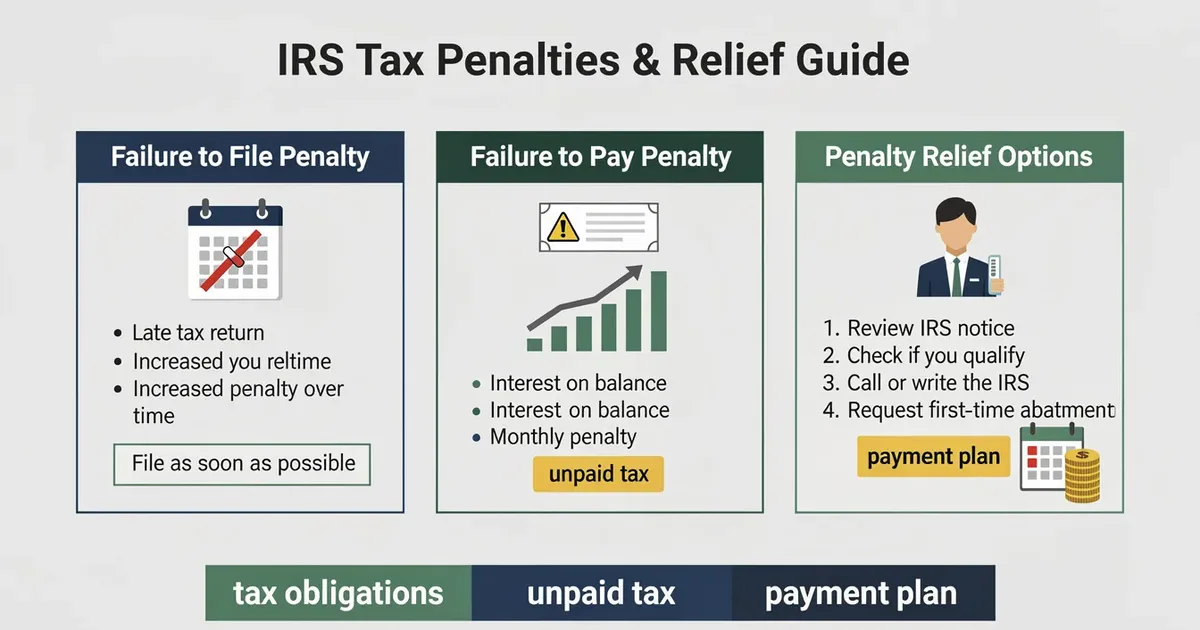
The billing summary is the part worth reading slowly. It separates the base tax from the failure-to-pay penalty (0.5% of the unpaid tax per month, capped at 25%) and interest (the federal short-term rate plus 3%, compounded daily). That split matters because each piece has a different fix: tax you genuinely owe gets paid or put on a plan, penalties can often be abated, and interest falls away automatically on whatever gets removed or corrected.
Want this done for your actual notice?
Upload your CP14 and get a free plain-English breakdown of what's tax, what's penalty, your exact deadline, and which response fits your situation.
Your 21-day window, and the escalation behind it
The CP14 shows a specific due date, typically 21 days from the notice date(10 business days if the balance is $100,000 or more). Pay in full by that date and the matter ends there: no additional failure-to-pay penalty accrues on what you paid, and no further notices follow. Miss it, and interest and penalties keep building while the IRS moves down a predictable path:
- CP501, a first reminder, usually about five weeks later.
- CP503, a second, more urgent reminder.
- CP504, "Notice of Intent to Levy," sent certified mail; it lets the IRS take your state tax refund and signals a federal tax lien may be filed.
- LT11 or Letter 1058, the final notice that, after 30 days, permits levies on wages and bank accounts (and gives you the right to a Collection Due Process hearing).
The whole sequence can play out in a few months. Nothing dramatic happens the day after a missed CP14 deadline, but every later stage adds cost, urgency and paperwork that a response today avoids entirely.
Your four options
Every CP14 response falls into one of four paths, and you can combine them (for example, a payment plan plus a penalty abatement request):
How to respond, step by step
Verify the balance before paying anything
Log into your IRS online account (or pull your account transcript) and compare it with your own records: did every payment post, to the right year? Does the tax match your filed return?
Decide your path: pay, plan, dispute, or hardship
If the amount is right, choose between full payment and a plan based on what you can pay without missing essentials. If it's wrong, gather your proof of payment before contacting anyone.
Act by the date on the notice
Pay via Direct Pay or your online account, or submit the payment-plan application online the same day. If disputing, call the number on the notice or reply in writing with copies (never originals) of your proof.
Request penalty abatement in the same motion
If penalties appear in the billing summary and you have a clean recent history or a good reason for paying late, ask for abatement now (see below), as it's a request, not a confession.
Keep the paper trail
Save payment confirmations, plan acceptance letters, and notes of any call (date, agent ID, outcome). If a reminder notice crosses your response in the mail, this record resolves it quickly.
The lever most people miss: penalty abatement
Buried in most CP14 balances is a chunk that isn't tax at all, it's penalty, and penalties are the one part of an IRS bill that's routinely forgiven on request.
First-time abatement (FTA).If you filed (or validly extended) and paid on time for the previous three tax years, with no penalties in that window, the IRS can remove failure-to-file and failure-to-pay penalties for a single period essentially because you asked. It's an administrative waiver, not a judgment call, many people qualify without knowing it, and a phone call or short written request is enough to invoke it.
Reasonable cause.If FTA doesn't fit, penalties can still be removed when circumstances genuinely beyond your control caused the late payment: serious illness, a death in the family, a natural disaster, or records being unobtainable. The request should tell a short, dated, factual story and attach what documentation exists.
"But I already paid this", what to do
If you paid before the notice arrived, don't pay again and don't assume the letter self-resolves. First check whether the payment has postedin your IRS online account, processing can lag by weeks for mailed checks. If it shows up, the notice and payment simply crossed; you can note the confirmation and move on. If it doesn't, respond with proof: the front and back of the canceled check, the Direct Pay or EFTPS confirmation number, or the card statement line. If the payment was applied to the wrong year or the wrong spouse's account, say exactly that, misapplied payments are corrected by tracing, not by paying twice. When a payment genuinely vanished, ask the IRS to initiate a payment trace rather than treating the money as gone.
Five mistakes that make a CP14 worse
- Paying instantly without checking the math, misapplied payments and premature notices are common; ten minutes of verification can save the whole amount.
- Ignoring it because the amount is small, small balances ride the same escalator to CP504 and beyond, growing the whole way.
- Mailing a check with no follow-up, if it doesn't post, the reminders keep coming; electronic payment or certified mail gives you proof and a date.
- Not asking about penalty relief, first-time abatement is never applied automatically; unclaimed, it simply expires into the balance.
- Promising a payment plan you can't sustain, a defaulted installment agreement triggers a CP523 and puts you back in the collection sequence with less goodwill.
CP14, Frequently asked questions
Is a CP14 notice a real bill?
How long do I have to pay a CP14?
What if I already paid the amount on my CP14?
What happens if I ignore a CP14?
Can I set up a payment plan for a CP14 balance?
Can the penalties on a CP14 be removed?
Related notices
Browse the complete directory of IRS notices orlook up any notice number.