
Penalties for IRS: Failure to File, Failure to Pay, and How to Request Penalty Relief
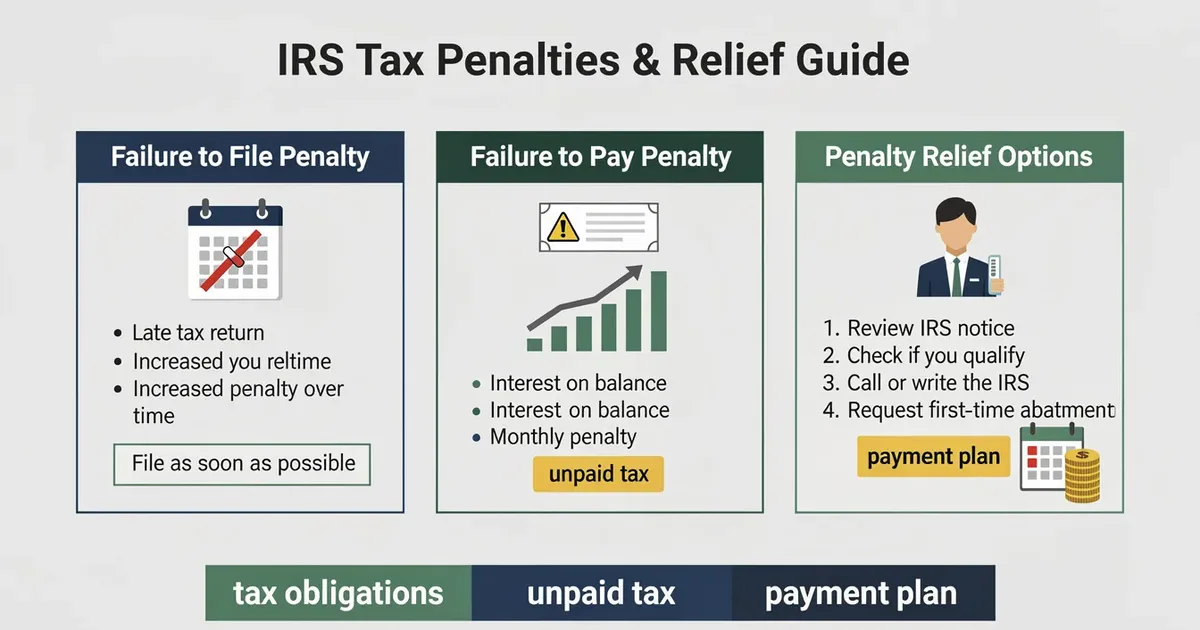
If you've received an IRS notice or letter about a penalty, you're not alone. Millions of taxpayers face IRS penalties each year, and the language in those letters can make a stressful situation feel worse. This guide breaks down the most common tax penalties, explains how they're calculated, and walks you through your options for relief and payment.
Overview: How IRS Penalties Work and Why They Matter
IRS penalties are charges the Internal Revenue Service adds to your tax bill when you don't meet specific tax obligations on time. The IRS imposes separate penalties for late filing and late payment of taxes, and each one works differently.
The three most common IRS penalties are:
Failure to file penalty (not submitting your tax return by the due date)
Failure to pay penalty (not paying tax owed by the deadline)
Estimated tax penalty (not paying enough tax during the year through withholding or estimated payments)
The IRS calculates most of these penalties as a percentage of unpaid tax for each month or partial month after the tax deadline. For most 2025 individual returns, that deadline is April 15, 2026.
Penalties are not the same as interest. Interest on unpaid taxes compounds daily until paid in full, and the IRS also charges interest on many penalties. Together, penalties and interest can turn a manageable tax liability into a much larger problem over time.
ClearNotice helps taxpayers understand IRS letters about penalties, deadlines, and how to respond. It does not file returns or set up payment plans directly-it translates what the IRS is telling you into plain English so you can take action.

Failure to File Penalty: Missing the Tax Deadline
The failure to file penalty is typically the most expensive IRS penalty. It applies when you don't file your tax return by the due date (or extended due date) and you owe tax.
For 2025 Form 1040 returns, the filing deadline is April 15, 2026. If you request an extension using Form 4868, you get until October 15, 2026, to file-but not to pay. Any income tax owed is still due by April 15.
Here's how the IRS calculates the late filing penalty:
The failure-to-file penalty is 5% of unpaid tax per month (or part of a month) the return is late
Being even one day into a new month counts as a full month
The maximum failure-to-file penalty caps at 25% of unpaid tax
Once a return is more than 60 days late, a minimum penalty kicks in. The failure-to-file minimum penalty after 60 days is the lesser of $525 or 100% of unpaid tax (for returns due after December 31, 2025).
Filing your return-even if you cannot pay in full-stops the file penalty from growing. The failure to pay penalty and interest still apply, but at a much lower rate than the failure to file penalty.
ClearNotice can decode failure-to-file IRS notices (such as CP14-style letters) so you know exactly what triggered the penalty, the amount assessed, and your next steps and dates.
Failure to Pay Penalty: Late Payment After Filing
The failure to pay penalty is a separate charge for unpaid tax after the original due date. It applies even if you filed your tax return on time or with an extension.
Key details:
The failure-to-pay penalty is 0.5% per month of unpaid tax (or any partial month where overdue taxes remain unpaid)
The maximum failure-to-pay penalty caps at 25% of unpaid taxes
If the IRS issues a notice of intent to levy and the tax remains unpaid after 10 days, the rate increases to 1% per month
When both failure to file and failure to pay penalties apply during the same month, the IRS reduces the failure-to-file portion. Instead of paying 5% + 0.5%, you pay 4.5% (file) + 0.5% (pay) = 5% total for that month. When both penalties apply, the failure-to-file penalty is reduced by the failure-to-pay penalty.
The IRS calculates the failure to pay penalty separately on underreported tax that is later assessed-for example, after an audit or CP2100A notice. Additional notices will show that calculation.
Making partial payments reduces the unpaid balance, which lowers future failure to pay penalty and interest amounts, even if you can't pay tax in full at once. Your IRS letter will typically itemize the failure to pay penalty with specific dates, and ClearNotice can help you interpret that breakdown.
Estimated Tax Penalty: Underpayment of Estimated Taxes
Federal tax law operates on a "pay as you go" system. You're expected to pay enough tax throughout the tax year through withholding or estimated payments-not just at filing time.
The estimated tax penalty (also called the IRS underpayment penalty) applies when you don't pay enough tax during the year and owe more than a threshold amount at filing. Underpayment penalties apply if you owe more than $1,000 at filing.
The IRS calculates this penalty period by period across the year, based on when estimated tax payments or withholding should have been paid versus when they actually were. Even if you pay the full balance by the tax deadline, the penalty can still apply if your payments during the year were too low or too late-this is an underpayment of estimated tax issue, not a late payment issue.
Common triggers for the estimated tax penalty include:
Self-employment income or side gigs
Investment income (capital gains, dividends)
Reduced withholding after a job change or retirement
Partnership income that flows through to your personal return
Safe harbor rules can help you avoid this penalty. Generally, if you paid at least 90% of the current year's tax or 100% of prior-year tax (110% if your adjusted gross income exceeds $150,000), you're covered.
IRS notices about underpayment of estimated tax-often tied to Form 2210 calculations-can be especially confusing. ClearNotice explains what "estimated tax penalty" lines and dates mean in those letters.

Other Common IRS Penalties: Accuracy, Dishonored Checks, and Employment Taxes
Beyond failure to file and failure to pay, several other penalties show up on IRS notices.
Accuracy related penalties apply when you substantially understate your income tax or make errors due to negligence. Accuracy-related penalties are generally 20% of the portion of underpayment attributed to errors or negligence. These civil penalties are separate from criminal penalties that apply in cases of intentional tax fraud, which can also violate tax laws.
The dishonored check penalty applies when a payment bounces or is rejected for insufficient funds. The dishonored check penalty is 2% of the check amount for payments of $1,250 or more, and the lesser of $25 or the payment amount for smaller payments. Always verify you have sufficient funds before submitting a tax payment.
Employers may incur penalties for failing to submit employment taxes accurately or on time. These penalties cover payroll taxes such as withheld Social Security, Medicare, and income tax. Trust fund recovery penalties can make business owners personally liable. Household employers who pay nanny or caregiver wages face similar obligations, and penalties on excise taxes and employment taxes can escalate quickly.
This section is intentionally high-level. If your IRS penalty notice involves accuracy, employment, or dishonored payment penalties, ClearNotice can clarify what your letter says, but you may also want professional help for detailed representation.
How the IRS Calculates Penalties and Interest
IRS calculations can seem opaque because multiple penalties apply at different times and interest rates change quarterly. Here's a simplified framework.
The IRS calculates penalties based on unpaid tax-your total tax liability minus withholding, estimated payments, and refundable tax credits. That unpaid tax figure is what percentage-based penalties are applied to.
For interest:
IRS interest on underpayments is the federal short-term rate plus 3%, compounded daily
The IRS adjusts interest rates quarterly based on federal short-term rates
As of early 2026, the rate for individual underpayments is 7% annually
IRS interest on penalties compounds daily until paid in full
The IRS charges interest on penalties starting from the due date
When the IRS calculates your balance, a typical notice or account transcript shows separate line items and dates for each penalty type, related interest, and the tax shown on your return. The IRS charges interest on a penalty from the original due date of the return, which is why even small penalties can grow if the tax remains unpaid for months.
ClearNotice does not replace official IRS calculations but helps you read each line in your letter, understand which penalty is which, and spot obvious mismatches to discuss with the IRS or a tax professional.
Requesting Penalty Relief: Abatement, Reasonable Cause, and First-Time Relief
Many taxpayers can request penalty relief, and the IRS offers several paths to remove or reduce penalties.
The IRS may waive penalties for first-time offenders under AEP (Automatic Exemption from Penalty), which began rolling out in mid-2026. Under AEP, eligible taxpayers with a clean compliance history-three prior years of timely filings and no penalties-receive automatic relief on failure to file, failure to pay, and failure to deposit penalties. No action is required. For returns not covered by AEP, First Time Penalty Abatement (FTA) may still be available; see our IRS First Time Penalty Abatement guide for details.
You can request penalty abatement for reasonable cause. Qualifying situations include serious illness, natural disaster, death in the family, or other events beyond your control that made timely filing or payment impossible. Supporting documents such as medical records or disaster declarations strengthen your case. Taxpayers can request relief from penalties under certain reasonable cause conditions, though approval isn't guaranteed.
Statutory exceptions and reliance on written IRS advice are narrower grounds for relief and typically require written proof referencing specific IRS letters or publications.
Steps to request penalty relief:
Call the phone number on your IRS notice
Write a letter explaining the circumstances (a penalty abatement request)
Or have a representative submit a written request, sometimes using Form 843
ClearNotice helps you locate the relevant paragraph in your notice about how to request penalty relief, understand any response deadline, and prepare a focused explanation instead of a generic appeal.
Disputing Penalties and Appealing an IRS Decision
If you believe a penalty was assessed in error or the amount is wrong, you can dispute it-this is different from asking for mercy.
The first step is to respond to the penalty notice: call the IRS or send a written explanation with supporting documents (proof of timely filing, prior payments, or corrected income figures). Keep copies of everything you send.
If the IRS denies your request to remove or reduce penalties, you may have the right to request a conference with the IRS Independent Office of Appeals, typically within 30 days of the denial letter. You can learn more about where to send correspondence to the IRS based on your notice instructions.
Key points for appeals:
Follow exact addresses and deadlines in your letter
Missing dates can permanently limit your options to dispute interest or penalties
Include a clear written statement of why you disagree
Some disputes involve complex legal questions. While ClearNotice clarifies what the letter says and what the deadlines are, a tax professional or tax attorney is often appropriate for detailed representation before the IRS independent office.
Paying a Penalty: Options for Late Payment and Payment Plans
Paying your tax and penalties as soon as possible limits further late payment penalties and interest, even if full payment isn't possible right away.
Common IRS payment options:
Method | Speed | Notes |
|---|---|---|
IRS Direct Pay | Same day | Free, directly from bank account |
Debit/credit card | Same day | Processing fees apply |
EFTPS | 1–2 days | Requires enrollment |
Check or money order | 5–10 days | Mail to address on notice |
If you cannot pay in full, you can apply for an approved payment plan (installment agreement). Set up a payment plan to reduce future penalties-under an installment agreement, the monthly failure to pay rate drops from 0.5% to 0.25% if your return was filed on time. Penalty and interest continue to accrue while a balance remains, but at a lower rate compared to no arrangement.
IRS notices often include an "Amount You Owe" section. ClearNotice highlights these parts and their specific due dates so you can pay penalty amounts or owe tax balances by the right deadlines. Pay at least something by each deadline to reduce future charges.
Preventing Future IRS Penalties
The simplest way to avoid IRS penalties: file your tax return by the due date, pay your taxes in full by the deadline, and keep up with required estimated tax payments during the year.
Practical steps:
Use calendar reminders for the April tax deadline and quarterly estimated tax due dates (April, June, September, January)
Adjust paycheck withholding after income changes so you pay enough tax throughout the year
Request an extension if you need more time to file-Form 4868 prevents a failure to file penalty but does not stop the failure to pay penalty or interest from accruing on unpaid tax after April 15
Revisit estimated taxes at least once per quarter if you have side income or fluctuating self-employment income, to avoid an estimated tax penalty at year-end
Review prior-year penalties to understand what went wrong
Open IRS letters immediately. Many penalties and deadlines begin counting from the notice date. Ignoring a letter doesn't make the penalties apply any less-it just costs you more.
Using ClearNotice whenever an IRS letter arrives helps you understand what the IRS is asking for, which penalties are involved, and what actions keep you compliant.

How ClearNotice Helps You Understand IRS Penalties and Letters
ClearNotice is a digital service that decodes IRS notices about penalties, interest, and balances due into plain language. Instead of guessing what a notice or letter means, you get a clear explanation of each section.
Here's how it works at a high level: upload or view your IRS letter and receive an explanation of key elements-penalty types (failure to file, failure to pay, estimated tax penalty), dates, amounts, and immediate next steps.
ClearNotice highlights critical deadlines: dates to pay, dates to request penalty abatement, and dates to file an appeal, so you don't miss time-sensitive opportunities.
ClearNotice does not replace a CPA, enrolled agent, or attorney. It helps you arrive prepared for those conversations by understanding your IRS correspondence in advance. Think of it as the step between receiving a confusing tax bill and making an informed decision about what to do next.
Use ClearNotice at multiple points: when the first IRS penalty letter arrives, before calling the IRS, and when reviewing follow-up letters about adjusted penalty or interest amounts.
IRS penalties and notices can feel intimidating. But clear explanations and timely action can significantly reduce both stress and cost. Upload your IRS letter to ClearNotice today to see exactly what your notice means and what to do next.
Keep reading
 Penalties & abatement
IRS Insufficient Funds Penalty: What to Do Next: IRS Guide
If your IRS payment bounced, a dishonored payment penalty may already be on your account. This guide explains how the IRS insufficient funds penalty works and what to do fast.
 Penalties & abatement
IRS Underpayment Penalties: What You Need to Know: IRS Guide
The IRS charges underpayment penalties when you don't pay enough tax throughout the year. This plain-English guide explains how the penalty is calculated and how to avoid it.
 Penalties & abatement
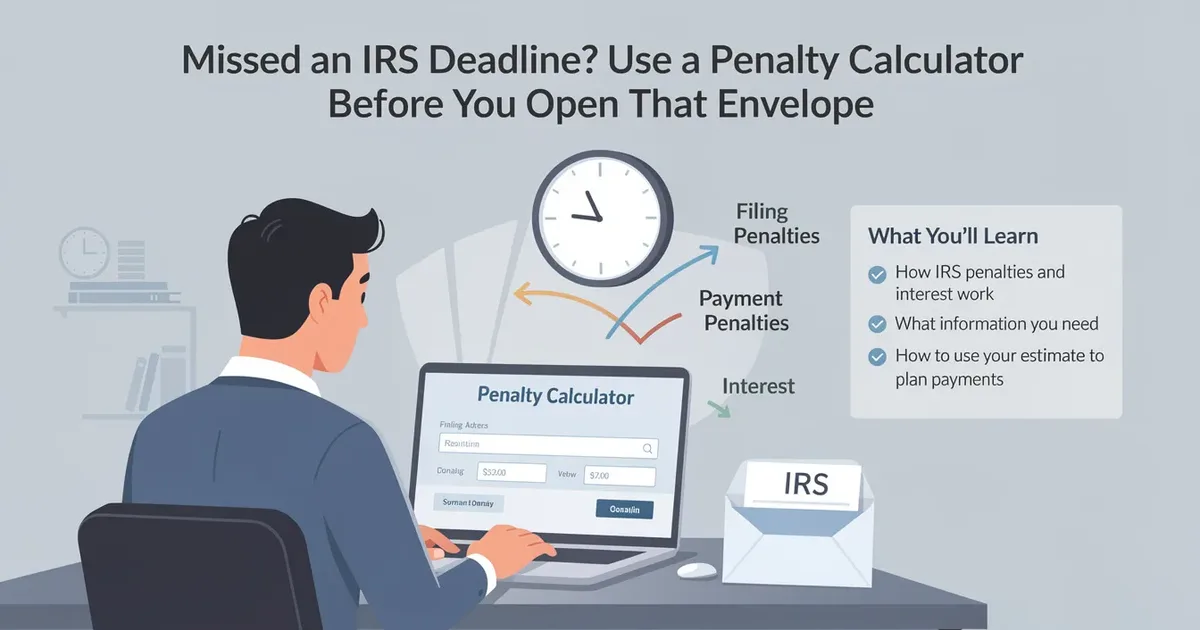
Penalty Calculator IRS: Estimate What You Owe: IRS Guide
Missed an IRS deadline? An IRS penalty calculator helps you estimate late filing and payment penalties before your notice arrives, so you can make smarter payment decisions.