
How much is the IRS failure to pay penalty?
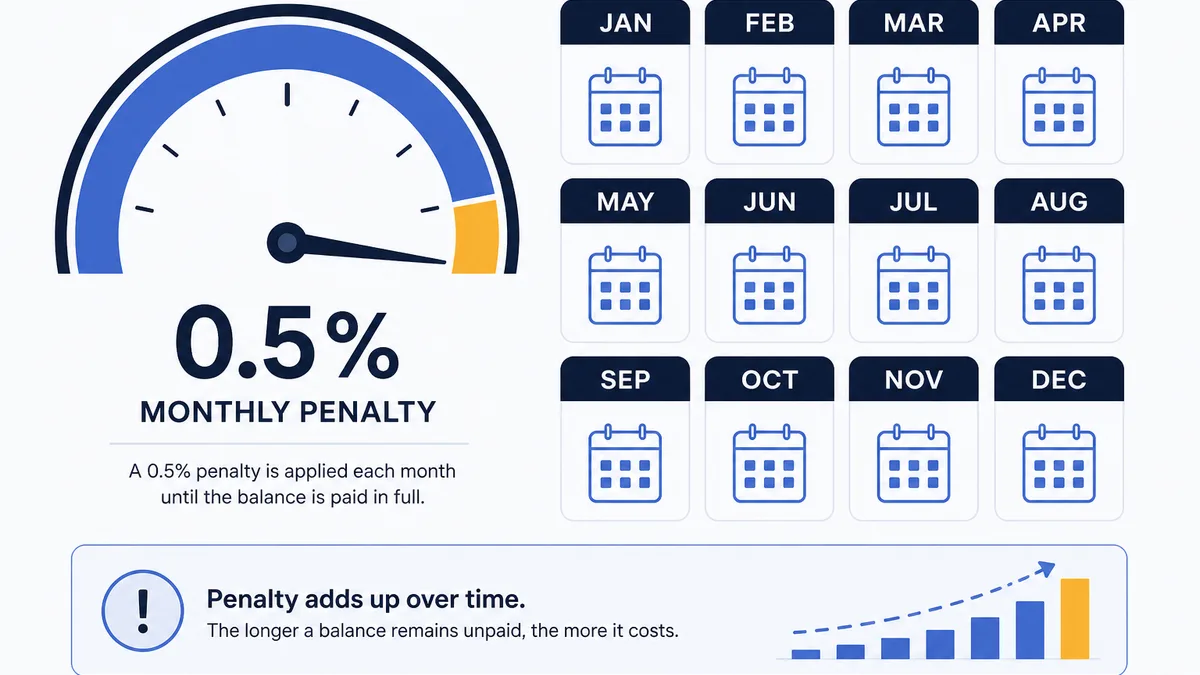
The IRS failure to pay penalty is generally 0.5% of the unpaid tax for each month or part of a month the tax remains unpaid, up to a maximum of 25% of the unpaid tax. If you are under an installment agreement, that monthly rate is often reduced to 0.25% while the agreement stays in good standing. Interest is separate. Exact dollars still depend on your dates, payments, and notice figures, so treat examples as teaching tools, not a substitute for your transcript.
Where the penalty appears
A first balance due letter such as a CP14 often lists tax, penalties, and interest on separate lines. The failure-to-pay amount is tied to unpaid tax after the due date, not to every fee the IRS might ever assess. Before you argue or pay, confirm:
- Tax year and form
- Unpaid tax (not the full balance including old interest)
- Whether any payments posted after the notice printed
- Whether you are already in an installment agreement
ClearNotice’s penalty calculator helps you explore month-by-month growth using the published percentage pattern so the cost of waiting is easier to see.
The core IRS-style rules (general individual pattern)
These are the headline rules taxpayers meet most often for income tax failure to pay. Always read your notice and IRS.gov pages for your situation, especially if employment taxes or special assessments are involved.
- Monthly rate: 0.5% (one-half of one percent) of the unpaid tax for each month or part of a month the tax is unpaid.
- Maximum: Generally 25% of the unpaid tax.
- Installment agreement reduction: While a qualifying installment agreement is in effect, the monthly failure-to-pay rate is often 0.25% (one-quarter of one percent) instead of 0.5%, still subject to the overall maximum.
- Part months count: A partial month typically counts as a full month for this penalty’s monthly charge.
- Payments reduce the base: As unpaid tax falls, later monthly charges are computed on the remaining unpaid tax, not forever on the original high-water mark.
Interest runs on its own track. Paying down tax helps both problems, yet removing confusion between the two lines prevents false relief expectations.
Careful sample calculation (teaching only)
Assume these simplified facts. They are not your case.
- Unpaid income tax after the due date: $4,000
- No installment agreement yet
- Tax remains fully unpaid for 6 full months (and no partial-month quirks beyond those six monthly charges)
- No other penalties mixed into the arithmetic
0.5% of $4,000 = 0.005 × 4,000 = $20 per month
Step B: Six months$20 × 6 = $120 failure-to-pay penalty so far
Step C: Check the 25% cap25% of $4,000 = $1,000 maximum failure-to-pay on this unpaid tax figure.
$120 is well under the cap, so the cap does not bind yet.
Monthly rate 0.25% of $4,000 = 0.0025 × 4,000 = $10 per month
Over the same six months: $60
This comparison shows why a real plan can cut the failure-to-pay burn rate even when interest continues. It does not claim your notice will print these exact dollars. Posting dates, partial payments mid-month, and combined penalty rules can change the worksheet.
Partial payment midstream (still teaching)
Same $4,000 start, no plan, 0.5% rate:
- Months 1 to 3: unpaid tax still $4,000, so $20 + $20 + $20 = $60
- After month 3 you pay $1,000 of tax, so unpaid tax becomes $3,000
- Months 4 to 6: 0.5% of $3,000 = $15 each, or $45
- Total failure-to-pay in this sketch: $105
The lesson: earlier tax payment shrinks later monthly penalty charges. Waiting while cash sits idle is expensive even before interest.
How the 25% cap behaves in plain English
At 0.5% per month, reaching 25% takes a long calendar stretch if the unpaid tax never drops (0.5% × 50 months = 25%). Life rarely looks that clean. People pay partly, enter plans, or see other assessments. Still, the cap matters: the failure-to-pay penalty is not endless percentage stacking without a statutory ceiling on that penalty type.
Do not confuse “capped penalty” with “frozen balance.” Interest can keep moving after a penalty hits its maximum.
Installment agreements and the 0.25% rate
The reduced monthly rate is a major reason plans are about more than courtesy. If you can sustain payments, formalizing them may cut the failure-to-pay percentage while you catch up. Keep the agreement current. Default can return you to less favorable treatment and stronger collection tools.
A plan does not delete the penalty already assessed for past months. It changes how new monthly failure-to-pay accrues going forward under the reduced-rate rule when you qualify.
If a later collection notice sets a levy date, do not treat the 0.5% worksheet as your only calendar. Levy timing can move faster than penalty math. Contact the IRS or establish an agreement before bank or wage levy action when a final notice warns that seizure may begin.
Failure to pay versus failure to file
Failure to file uses a different percentage structure and serves a different purpose: returns that never arrived (or arrived late) without enough payment. People often owe both stories on one year. IRS rules coordinate how those penalties interact month by month so you are not always charged a simple sum of both full rates for identical months. When both appear on your notice, read each line and, if needed, get transcript-level help rather than adding headline percentages by hand.
What this penalty is not
- It is not the negligence or accuracy-related penalty.
- It is not interest.
- It is not a user fee for an installment agreement.
- It is not automatically wiped by a phone call without a relief basis or payment change.
First time penalty abatement or reasonable cause may remove a failure-to-pay assessment when you qualify. Those paths are separate from understanding the 0.5% engine itself.
Practical next steps
- Pull the unpaid tax figure from the notice or transcript.
- Note whether you are already under an installment agreement.
- Estimate months of accrual with the penalty calculator.
- Pay tax as soon as you can, or formalize a plan you can keep.
- Ask about penalty relief only after you know which penalty codes you face.
Reading the CP14 explainer helps you see how first bills present these lines before later collection letters raise the stakes.
Bottom line
How much is the IRS failure to pay penalty? Under general rules, expect 0.5% of unpaid tax per month or partial month, capped at 25%, with a common drop to 0.25% per month during a qualifying installment agreement. Run the arithmetic on unpaid tax, not on a blended balance that already mixes interest. Use official notices and calculators for your dates, and remember that interest remains a second meter even when you understand the penalty perfectly.
Quick follow-ups
Is the failure to pay penalty the same as interest?
No. The failure to pay penalty is a separate add-on. Interest is calculated under its own rules and can continue even when penalty questions are still open.
Does an installment agreement change the monthly rate?
Under common IRS rules, the monthly failure-to-pay rate can drop to 0.25% while you are under an installment agreement and meeting its terms, until the usual maximum is reached.
What if I also filed late?
Failure to file is a different penalty with its own rate structure. When both apply for the same month, IRS coordination rules can limit stacking in ways that depend on the facts and dates.
Upload a photo for a free plain-English explanation of your amounts, deadline, and options.

Founder of ClearNotice · Updated August 2026 · About