
IRS Form 843: Claim for Refund and Request for Abatement
If the IRS hit you with a penalty or interest charge you believe is wrong, Form 843 may be your path to relief. This guide walks you through everything you need to know about IRS Form 843, from when to use it and how to fill it out, to deadlines, evidence requirements, and what happens after you mail it in.
Quick Answer: What Is IRS Form 843 and When Should You Use It?
IRS Form 843, officially titled "Claim for Refund and Request for Abatement," is the form you use to ask the internal revenue service to reduce or refund certain taxes, penalties, interest, and fees. Form 843 is used to claim a refund or abatement, and it is used to request tax refunds or abatements across several categories. It is not connected to annual income tax returns and cannot fix errors on a tax return like a missed deduction or incorrect income figures.
Taxpayers typically file form 843 after receiving an irs notice that shows a penalty or interest charge they believe is wrong, unfair, or caused by irs error or a qualifying hardship like a natural disaster or serious illness.
Common uses include:
Requesting penalty abatement for failure-to-file, failure-to-pay, or accuracy related penalty assessments
Asking the IRS to abate interest due to unreasonable error or delay by the IRS
Requesting refunds of certain employment, excise, estate and gift taxes
Claiming a net interest rate of zero where overpayments and underpayments overlap under Rev. Proc. 2000-26
Requesting refunds of social security and medicare taxes withheld in error from nonresident aliens
Form 843 requests abatement of certain penalties and interest charges assessed on your IRS account. However, if you need an income tax refund correction, you need Form 1040-X (the amended individual income tax return), not Form 843. Using the wrong form can delay your claim by months.
ClearNotice helps taxpayers understand the irs notice that led them to Form 843 by translating IRS language into clear next steps and deadlines, so you can decide whether Form 843 is the right move before investing time in preparing it.
How IRS Form 843 Fits Into the IRS Notice Process
Form 843 is almost always a reaction to an IRS notice or letter. You generally don't file it out of the blue. Instead, it follows a penalty notice, balance-due letter, or interest assessment that you believe deserves a second look.
Typical IRS notices that trigger a Form 843 filing include:
CP14 – Balance due on your account
CP161 – Underpayment notice for business accounts
Letters assessing penalties – With specific penalty codes referencing Internal Revenue Code sections like § 6651 (failure to file/pay) or § 6662 (accuracy-related)
The IRS notice will usually list the tax period, type of tax involved, the penalty or interest amount assessed, the internal revenue code section that imposes the charge, and the office or service center address for correspondence.
Keep the original IRS notice. When you file form 843, attach a copy of the notice because it shows the IRS exactly what you are disputing and helps them match the claim to your account. Missing this step often causes delays or outright denial.
ClearNotice can decode a scanned IRS notice, explain which parts relate to Form 843 (penalty code, dates, tax period), and identify relevant deadlines for filing a claim for refund or request for abatement.
When You Can and Cannot Use Form 843
Success with Form 843 starts with using it in the correct situations. Filing it for the wrong purpose leads to automatic denial and wasted time.
Valid uses of Form 843:
Abating a late filing penalty, failure-to-pay penalty, or accuracy related penalty when reasonable cause exists
Claiming a refund of certain taxes like employment tax or certain excise taxes
Requesting interest abatement when interest resulted from irs error or unreasonable delay
Asking for a net interest rate of zero when underpayments and overpayments overlap under Rev. Proc. 2000-26
Requesting refunds of social security and medicare taxes erroneously withheld from certain nonresident aliens (e.g., F-1 or J-1 visa holders)
Disputing specific fees and assessments related to certain excise taxes
What Form 843 cannot do:
It cannot be used for income, estate, or gift tax refunds. To correct income on an income tax return, you must use Form 1040-X
It cannot remove the underlying tax itself in most cases
It cannot be used for FBAR penalties or non-Title 26 issues
Employers cannot use Form 843 to correct FICA or income tax withholding; they must use specific forms like 941-X
Filing Form 843 for the wrong purpose usually means automatic denial. ClearNotice can help you confirm that the notice you received actually fits a Form 843 situation before you invest time preparing it.
Understanding "Claim for Refund" vs. "Request for Abatement"
Form 843 covers two related but different ideas, and understanding the distinction matters for how you fill it out.
Claim for refund: You already paid the penalty or interest shown on an IRS notice, you believe it was improper or excessive, and you want your money back. You check the appropriate box on Form 843 indicating a refund, enter the date and amount of your payment, and ask the IRS to return it.
Request for abatement: The penalty or interest is assessed on your IRS account but you have not paid it yet. You are asking the IRS to remove it entirely so you never have to pay it.
The same Form 843 can function as both. For example, suppose you received a CP161 notice for tax year 2022 showing a $1,000 penalty. You paid $600 in March and the remaining $400 is still outstanding. Your Form 843 would request a refund of the $600 already paid and abatement of the $400 still owed.
Paying first can stop interest from growing on the unpaid penalty balance. Then filing as a claim for refund lets you recover the money once the IRS approves your request. This approach is sometimes recommended when balances are large and the net interest charges are increasing daily.

Deadlines: How Long You Have to File Form 843
IRS deadline rules for Form 843 generally follow internal revenue code section 6511, and missing them usually means automatic denial with very few exceptions.
Standard limitations period:
To file a refund claim, the IRS generally requires submission within three years after the original return was filed (or its due date if filed early) or two years from the date the tax or penalty was paid, whichever is later. You must file Form 843 within three years of your original return in most situations.
Example: You filed your 2022 individual income tax return on April 15, 2023. The IRS assessed a penalty, which you paid on August 1, 2024. Your deadline to file Form 843 is the later of:
April 15, 2026 (three years from the filing date), or
August 1, 2026 (two years from the payment date)
In this case, August 1, 2026 is your deadline.
No return filed: If no return was filed, you typically have two years from the date the tax or penalty was paid.
Special extensions:
Some situations extend deadlines. Under IRC § 7508A, taxpayers in federally declared disaster areas may receive postponed filing and payment deadlines. For example, the IRS postponed deadlines to July 8, 2026 for taxpayers affected by severe storms in Hawaii beginning March 10, 2026.
Your IRS notice may also have its own response deadline (for example, 30 days to reply) which is different from the statutory refund limitation period. ClearNotice can clarify which date matters for your specific letter.
Which Taxes, Penalties, and Interest Can Be Addressed with Form 843?
Form 843 applies to specific categories under the Internal Revenue Code, not every charge on your IRS account.
Tax types commonly covered:
Tax Type | Relevant Form | Notes |
|---|---|---|
Employment tax | Form 941, 940 | Payroll taxes, certain scenarios only |
Certain excise taxes | Form 720 | Various excise categories |
Estate tax | Form 706 | Estate and gift taxes in limited cases |
Gift taxes | Form 709 | Gift tax penalty/interest claims |
Information return penalties | W-2, 1099 | Late or incorrect filings |
Penalties commonly addressed:
Failure-to-file and failure-to-pay penalties
Failure-to-deposit payroll taxes
Accuracy related penalty assessments
Information-return penalties tied to IRS notices
Trust Fund Recovery Penalty (§ 6672)
Interest rules are narrow. You can request abatement of interest due to unreasonable IRS error or delay using Form 843, but you cannot get interest removed simply because you couldn't afford to pay. The IRS must have made a managerial or ministerial error that caused extra interest to accrue.
Interest related to the branded prescription drug fee is specifically non-abatable per IRS guidance. Form 843 cannot be used to remove such interest even if other related items may be disputed.
Reasonable Cause, IRS Error, and Other Grounds for Relief
Form 843 relief usually hinges on the reason behind the penalty or interest. The IRS recognizes several grounds for penalty relief, and penalty abatement is the most common reason to file Form 843.
Reasonable cause
The IRS accepts reasonable cause as a basis for penalty abatement. This means you exercised ordinary business care and prudence but still could not meet your tax obligations on time. The IRS provides specific reasons for filing Form 843, which include ill health or natural disasters, among others. Examples:
Serious illness or hospitalization during the filing deadline
A natural disaster that destroyed records or prevented access to a tax professional
Death of an immediate family member
Fire, flood, or other casualty that damaged records
You can request penalty abatement for reasonable cause using Form 843 by documenting exactly what happened and how it prevented compliance.
IRS error or delay
Under § 6404(e)(1), you can request that the IRS abate interest when unreasonable error or delay by an irs employee caused additional interest to accrue. This requires showing that the IRS contacted you in writing about a deficiency, that neither you nor your representative caused the delay, and that the error was ministerial or managerial in nature.
Erroneous written advice
If the IRS gave you erroneous written advice that led to a penalty, you can seek relief under § 6404(f). You must provide the original written advice along with your Form 843.
First-Time Abatement (FTA)
First-Time Abatement requires no prior penalties in three years. It is an administrative relief program that can remove certain penalties for taxpayers with clean compliance records. While FTA is often requested by phone, Form 843 can also memorialize the request in writing.
Vague explanations like "I forgot" or "I didn't understand the law" rarely qualify as reasonable cause. ClearNotice can help you translate your situation into IRS-recognized language before you write your Form 843 narrative.
Special Situations: Natural Disasters, Medicare Tax, and Net Interest Rate Zero
Some situations have unique handling on Form 843. Here are the most common special cases.
Natural disaster cases
Taxpayers in federally declared disaster areas may qualify for penalty relief when storms, floods, or wildfires prevent timely filing or payment. For example, taxpayers affected by severe storms in Hawaii beginning March 10, 2026 received postponed deadlines through July 8, 2026. Under H.R. 1491, these postponements are treated as extensions for purposes of calculating refund claim deadlines.
Medicare and Social Security tax errors
Nonresident aliens on certain visas (F-1, J-1) are exempt from FICA and medicare taxes. If an employer wrongfully withholds these taxes and will not correct the error, the employee can file form 843 to request a refund of medicare taxes withheld in error. Typical attachments include Form W-2, proof of visa status, and a letter from the employer explaining why they cannot adjust.
Net interest rate of zero
When an overpayment and underpayment overlap for the same taxpayer and tax period, Form 843 can be used to request netting under Rev. Proc. 2000-26. On the form, leave line 1 blank, complete lines 2, 4, and 5, and provide a detailed explanation of the overlapping periods and amounts in line 8.
Branded prescription drug fee
While some aspects of this fee may involve Form 843, interest tied to the branded prescription drug fee specifically cannot be abated. If you received Letter 4658 related to this fee, follow its instructions closely, as the rules differ from standard penalty claims.

Step-by-Step: How to Fill Out IRS Form 843
The IRS redesigned Form 843 in December 2024, so make sure you are working with the Rev. 12-2024 version. Form 843 requires specific header information and details about the claim. Here is a practical walkthrough.
Top portion (header information):
Your name and address
Your Social Security number, ITIN, or employer identification number
The tax period (beginning date and ending date)
The reason checkboxes: select one to indicate your basis for filing
You need to check one box on Form 843 to indicate your reason for filing. Options typically group into tax, penalty, interest, or other categories.
Line-by-line:
Line | What to Enter |
|---|---|
Line 1 | Tax period beginning and ending dates |
Line 2 | Dollar amount you are requesting (refund or abatement) |
Line 3 | Date(s) of payment(s) already made (skip if unpaid) |
Line 4 | Tax type or fee type the claim relates to; check the appropriate box |
Line 5 | Type of return filed (e.g., 1040, 941, 720) |
Line 6 | Internal Revenue Code section imposing the penalty (from your IRS notice) |
Line 7 | Reason code: IRS error/delay, erroneous written advice, reasonable cause, or other |
Line 8 | Detailed explanation of your claim with supporting facts |
You must file a separate form 843 for each tax period or type of tax involved. Combining multiple years or tax types on one form often causes processing delays or denial.
Copy details directly from your IRS notice: the kind of tax, the internal revenue code section for the penalty, and the exact dollar amounts. This reduces the chance of matching errors on the IRS's end.
The narrative explanation on line 8 is the most critical part of the completed form. The next section covers how to craft it effectively.

Crafting a Strong Explanation on Form 843
IRS employees primarily decide Form 843 cases based on the written explanation, so clarity, organization, and evidence references make the difference between approval and denial.
Structure your detailed explanation chronologically:
Describe your normal compliance history. "I have filed and paid all federal taxes on time for the past five years."
State what went wrong. "On March 15, 2024, I was hospitalized for emergency surgery and remained incapacitated through April 20, 2024."
Explain how it prevented timely compliance. "I was unable to access my records or communicate with my tax professional during the filing deadline of April 15, 2024."
Show what you did once you could comply. "I filed my return on May 1, 2024, within 15 days of my hospital discharge."
Include concrete dates, IRS notice numbers, and references to attached documentation. For example: "See attached hospital discharge summary dated April 20, 2024" or "See FEMA declaration FEMA-4830-DR dated August 30, 2023."
Avoid emotional or accusatory language. Focus on facts, timelines, and how you exercised ordinary business care and prudence despite the hardship.
ClearNotice can help you decode complicated terms in your irs notice, identify which facts are legally relevant, and turn those into a clear, IRS-friendly explanation before filing.
Attaching Evidence and Supporting Documentation
Many otherwise valid Form 843 requests fail because they lack supporting documents that tie directly to the reasons claimed. Provide evidence linking your circumstances to the penalty for reasonable cause.
Evidence by scenario:
Serious illness: Medical records, hospital discharge summaries, doctor's letters confirming incapacity. Include documentation for medical crises or natural disasters affecting compliance.
Death in the family: Death certificates and funeral invoices showing timing and impact
Natural disaster: FEMA notices, insurance claims documentation, contractor invoices for property damage, local news reports
IRS error or bad written advice: Copies of erroneous written advice from the IRS, transcripts of prior calls when available, and contemporaneous notes with date, time, and agent name. Attach your written request for IRS advice if claiming reliance on incorrect guidance.
Excess tax refunds: Attach a statement from your employer for excess tax refunds. Include copies of Forms W-2 for excess tier 2 RRTA tax claims.
Organize attachments with labels (e.g., "Exhibit 1 – Hospital Discharge Summary") and reference those labels in the Form 843 explanation so an IRS reviewer can quickly match claims to evidence.
Always include a copy of the original penalty notice that led to the filing, with key amounts and dates highlighted. ClearNotice can help you understand which sections of the notice should be emphasized as supporting evidence.
Where to Mail Form 843 and Why Mailing Addresses Matter
Form 843 is a paper form, and choosing the correct IRS mailing address is critical to avoid months-long delays or lost claims. The IRS maintains multiple mailing addresses depending on the type of claim.
General rule: Mail Form 843 to the address shown on the IRS notice that assessed the penalty, tax, or fee. That notice's return or correspondence address is your primary guide.
Special mailing addresses:
Estate and gift taxes (Forms 706 and 709): IRS facility in Florence, Kentucky
Branded prescription drug fee matters: Dedicated address listed on Letter 4658
Employment tax and excise tax claims: Same service center where the original return (Form 941 or Form 720) was filed
Confirm your mailing address by checking the latest Instructions for Form 843 on the IRS website. These instructions list specific mailing addresses by claim type.
Use U.S. Postal Service certified mail with return receipt or another trackable method. Keep a complete copy of the filed Form 843 and all attachments in case the IRS asks for them again.
Submitting Form 843: Certified Mail, Tracking, and Address Changes
How you send Form 843 matters nearly as much as how you fill it out, because the IRS relies on mailroom intake and paper records for processing.
Form 843 cannot be e-filed; it must be mailed. There are no widely available electronic filing options for this form as of mid-2026. Check the IRS website for any limited e-filing pilot programs that may launch in the future.
Why certified mail matters:
It creates proof of your mailing date (critical for statute of limitations purposes)
It confirms delivery with a return receipt
It protects you if the IRS claims the form was never received
If you move after filing, submit Form 8822 (for individuals) or Form 8822-B (for businesses) promptly to update your mailing address with the IRS. This ensures that decision letters and potential refund checks in the form of cash payments or direct deposits reach the right place.
ClearNotice can help you track original IRS correspondence dates and set reminders to follow up if no response to your Form 843 arrives within a reasonable processing window.
Processing Times, IRS Responses, and What Happens Next
Processing Form 843 typically takes 3 to 6 months. Complex claims, such as net interest rate zero requests or large employment tax abatements, may take longer than 6 months to process. The IRS aims for faster processing, but claims are manually reviewed by IRS staff rather than processed automatically.
Expect longer processing times during peak filing seasons (January through April). If no response is received in 6 months, contact the IRS using the phone number on your original notice.
Typical outcomes:
Full approval: The penalty or interest is removed or refunded entirely
Partial approval: Only some periods or amounts are granted
Denial: The IRS rejects the claim with a written explanation
For context, only 12% of failure-to-file penalties were abated in 2019, so approvals are far from guaranteed. A well-documented claim with strong supporting evidence significantly improves your odds.
If denied, you may appeal to the IRS Independent Office of Appeals or, in some refund cases, file suit in U.S. Court of Federal Claims or federal district court. Appeal deadlines vary, so review the denial letter carefully.
ClearNotice can help you interpret the decision letter, understand whether the IRS granted full or partial relief, and identify any appeal deadlines in the fine print.
Privacy, Legal Disclosures, and Risks of Incorrect Information
Form 843 is covered by the Privacy Act and the Paperwork Reduction Act. The IRS requests the information under its authority to administer federal tax laws, and providing a taxpayer identification number is required under internal revenue code section 6109.
Information on Form 843 may be shared with the Department of Justice, state tax agencies, and other federal agencies for civil and criminal law enforcement purposes, consistent with routine uses disclosed in IRS privacy notices.
Knowingly providing false or misleading information on Form 843 can expose taxpayers to civil penalties, accuracy related penalty assessments, and in serious cases, criminal prosecution for fraud or false statements. Accuracy matters: misstating facts or misidentifying the tax year, IRC section, or cause can lead to denial and further scrutiny.
ClearNotice provides explanations of IRS notices and general guidance but does not replace legal or tax advice from a qualified tax attorney or tax professional, especially when large dollar amounts or potential fraud issues are involved.

How ClearNotice Helps You Respond to an IRS Notice with Form 843
ClearNotice is a digital service that decodes IRS letters and CP notices for U.S. taxpayers, helping them understand when Form 843 might be the right response. Instead of guessing at IRS terminology, you get a plain-language summary of what your notice means.
How it works:
Upload or enter details from your irs notice into ClearNotice
Receive a plain-language summary explaining what the notice means, key deadlines, and whether the issue involves penalties, interest, or special non income taxes that relate to Form 843
See which lines on Form 843 need information from the notice, including the tax year, notice number, penalty type, correct income details, and IRS office address
Get a checklist of supporting documents to gather before you file
ClearNotice focuses on clarifying terminology, timelines, and response options so you can decide whether to pay, request penalty relief via Form 843, amend a return using a separate form, or contact a professional for representation.
The service won't replace a tax attorney for high-stakes cases, but it gives you the confidence to understand what the IRS is actually saying before you respond. Whether you need to correct income figures, request abatement of irs rules violations, or simply figure out which beginning date and filing date apply to your situation, ClearNotice translates the fine print into action items.
If you are staring at a confusing IRS notice about penalties or interest, try ClearNotice to understand the letter before you file Form 843 or pick up the phone to call the IRS. Knowing what your notice says is the first step toward resolving it.
Keep reading
 Penalties & abatement
IRS Insufficient Funds Penalty: What to Do Next: IRS Guide
If your IRS payment bounced, a dishonored payment penalty may already be on your account. This guide explains how the IRS insufficient funds penalty works and what to do fast.
 Penalties & abatement
IRS Underpayment Penalties: What You Need to Know: IRS Guide
The IRS charges underpayment penalties when you don't pay enough tax throughout the year. This plain-English guide explains how the penalty is calculated and how to avoid it.
 Penalties & abatement
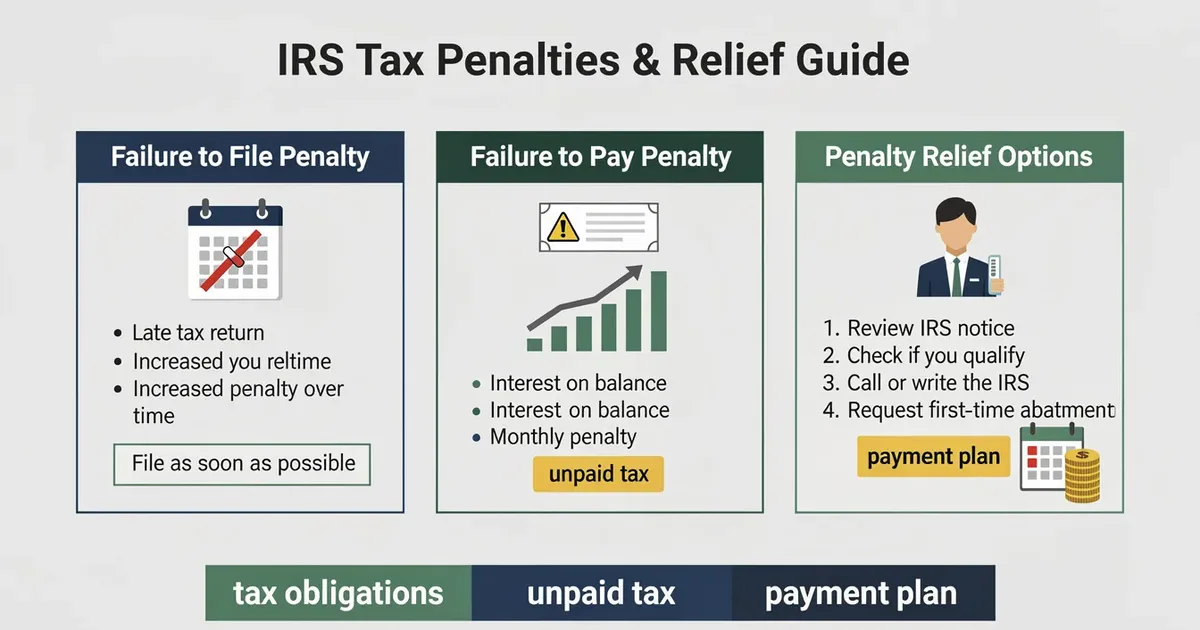
Penalties for IRS: Failure to File, Pay & Penalty Relief
Received an IRS notice about a penalty? This guide breaks down the most common IRS penalties in plain English, including how they are calculated and your options for relief.