
The 20% Accuracy Penalty on a CP2000: Can You Remove It?
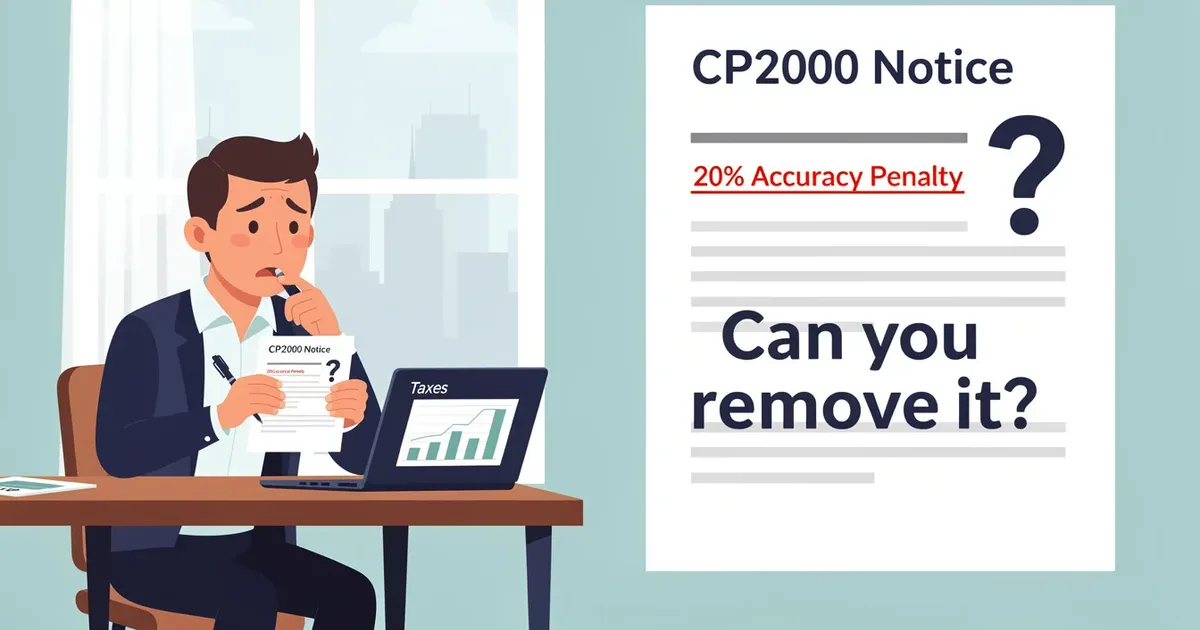
Getting an IRS notice in the mail is stressful enough. Seeing a 20% accuracy-related penalty tacked onto a proposed tax bill you didn't expect? That can feel like a punch in the gut. If you've received a CP2000 notice with this penalty, you're probably wondering whether you actually have to pay it or whether there's a way out. This guide walks you through exactly what this penalty is, when it can be removed, and how to build a response that gives you the best shot at getting it dropped.
Quick answer: Can you get the 20% CP2000 accuracy-related penalty removed?
Yes, the 20% accuracy-related penalty shown on an IRS CP2000 notice can often be removed or reduced. But only if you act before key deadlines and either correct the underlying tax calculation or show reasonable cause and a good-faith effort to comply with tax rules.
The penalty you see on a CP2000 is proposed, not final. A CP2000 notice is a proposal, not a final bill. That means you can contest penalties in your CP2000 response, using the same reply form and letter where you agree or disagree with the income changes.
This 20% penalty is different from late filing or late payment penalties. It's specifically about the accuracy of your original tax return and is governed by Internal Revenue Code § 6662. It typically appears when there's a substantial understatement of income tax or negligence.
Many taxpayers pay the extra tax but successfully get the accuracy-related penalty removed, especially when they quickly correct errors, provide supporting documents, or relied reasonably on a tax professional. You can contest the accuracy-related penalty by showing reasonable cause and good faith.
ClearNotice provides an online IRS notice decoder to help you understand whether your CP2000 accuracy-related penalty looks removable and what steps to take before the due date printed on the notice. Think of it as a free case review for your confusing IRS mail.

What is an IRS CP2000 notice and why the 20% penalty shows up on it
An IRS CP2000 notice, sometimes called an underreported income notice, is generated by the IRS's Automated Underreporter program. It fires when the income reported on your tax return doesn't match information the IRS receives from third parties like employers, banks, brokerages, and financial institutions.
The IRS sends over 6 million CP2000 notices yearly. The notice compares your filed return with data from W-2s, 1099-NECs, 1099-Bs, 1099-Ks, and other income documents, then proposes changes to your income, credits, and proposed tax. A CP2000 notice is not a bill or an audit. The notice indicates discrepancies between reported income and IRS records.
Once the IRS recalculates additional tax from unreported income or misreported items, it often adds a line for a 20% accuracy-related penalty. This is especially common where the proposed additional tax is large relative to what you originally reported.
Page one of the CP2000 typically summarizes the proposed adjustment, including additional tax, interest from the original due date (say, April 15, 2023, for a 2022 return), and any proposed penalties-accuracy penalties and sometimes failure-to-pay charges.
ClearNotice helps taxpayers upload a CP2000 notice and see a plain-English breakdown: what tax year it covers, what triggered it, the response deadline, and whether a 20% accuracy-related penalty is included.
Understanding the 20% accuracy-related penalty on a CP2000
The IRS accuracy related penalty is a 20% charge applied to the portion of your tax liability that was underpaid because of specific problems on your return. The penalty equals 20% of the portion of tax underpayment due to negligence or a substantial understatement.
The two most common triggers on CP2000 notices are:
Negligence or disregard of rules and regulations - failing to make a reasonable attempt to comply with tax law, like ignoring a 1099 you clearly received.
Substantial understatement of income tax - a substantial understatement exceeds the greater of 10% of the correct tax or $5,000 for individuals.
The 20% rate applies only to the underpayment tied to the issue, not to your total taxable income or total income tax. Higher 40% rates exist for special cases like gross valuation misstatements or undisclosed foreign assets, but those are rare on routine CP2000 mismatch cases.
This penalty is not about paying late (that's a separate failure-to-pay penalty) and not about filing late (failure-to-file). It's specifically about the accuracy of the original filed return. Multiple penalties cannot be stacked for the same error; the accuracy penalty is capped at a single charge per underpayment portion.
The CP2000 itself is often the first place you see this penalty proposed. Treat it as exactly that-a proposal you can still challenge before it becomes an assessed debt.
How the IRS calculates the 20% accuracy-related penalty on a CP2000
The IRS first recomputes your correct tax based on income, credits, and deductions it believes are accurate, using third-party reports and your return. It then compares that figure to the tax you originally reported and paid.
The difference is called the "underpayment"-the gap between the tax that should have been shown on a fully correct return and what was actually shown. The IRS then applies the 20% rate to the portion attributable to negligence or substantial understatement.
Here's a concrete example:
Item | Amount |
|---|---|
Tax originally reported on your return | $2,000 |
Correct tax per IRS (after adding omitted stock sales from 1099-B) | $10,000 |
Underpayment | $8,000 |
20% accuracy-related penalty | $1,600 |
Interest (accrues from original due date) | Varies |
If your response shows the IRS overstated income or used the wrong cost basis, and the underpayment drops from $8,000 to $2,000, the penalty is recalculated on the smaller amount ($400 instead of $1,600). In some cases, the corrected underpayment falls below the substantial understatement threshold altogether, and the penalty disappears.
The CP2000 notice lists computation lines for additional tax, proposed penalties, and interest. ClearNotice highlights which portion is extra tax and which is accuracy-related penalty when decoding a scanned notice.
Common CP2000 situations that trigger a 20% accuracy penalty
Not every CP2000 comes with a 20% penalty. But certain patterns make it far more likely:
Missing 1099-NEC income from gig work or non employee compensation that was never reported on Schedule C
Stock sales or crypto transactions reported on 1099-B where you didn't enter cost basis, so the IRS treats gross proceeds as pure capital gains
Unreported 1099-R distributions from retirement accounts, especially early distributions
1099-K income from payment apps like PayPal or Venmo that wasn't reported on Schedule C or elsewhere
Unreported interest or dividends from financial institutions
When you filed jointly, large understatements on a married filing jointly return can make the proposed penalty amount especially high because the IRS applies the 20% rate to the combined underpayment.
The IRS may also assert the penalty where the same type of mismatch happened in multiple tax years, signaling a pattern of disregard even if each individual year's underpayment isn't extreme.
To prevent future penalties, use a checklist to track all expected income documents each year. Report all income, even small amounts, to avoid mismatches. Review your tax return thoroughly before filing, and consider filing an extension to verify income before April 15 using IRS wage and income transcripts. Check those transcripts for accuracy against your own records.
Despite these triggers, the law still allows removal when you show reasonable cause, reliance on professional advice, or that the IRS's own calculation is wrong.
When the 20% accuracy-related penalty can legally be removed
The IRS can remove or reduce the accuracy-related penalty under two main paths:
No substantial understatement or negligence existed in the first place - your response proves the underlying tax was lower than IRS proposed, pushing the underpayment below thresholds.
Reasonable cause and good faith - even if the tax is correct, you can request penalty relief by showing reasonable cause under IRC § 6664(c).
For many CP2000 cases, the penalty disappears simply because the additional tax is corrected downward. Proving cost basis on stock sales, showing income was already reported income elsewhere on the return, or correcting misclassified income can shrink the underpayment enough to eliminate the penalty basis.
Reasonable cause factors include:
Whether you kept adequate records
Whether information returns like 1099s were sent late or with errors
Whether you reasonably relied on a competent tax preparer after giving full and accurate information
Whether you corrected the issue promptly once notified
The complexity of the tax issue involved
One important limitation: the accuracy-related penalty is not eligible for the First-Time Penalty Abatement waiver. You typically cannot use the First-Time Penalty Abatement for accuracy-related penalties. That program applies to failure-to-file and failure-to-pay penalties, not accuracy penalties. You need a real explanation backed by evidence.
You don't need to be perfect. You need to show you tried to comply with tax law and that the underpayment was not due to careless or willful disregard.
Reasonable cause arguments that work to remove a CP2000 accuracy penalty
Strong reasonable cause arguments focus on specific facts around the tax year in question: what information you had, what you did with it, and why the misstatement happened despite your effort to comply.
Fact patterns that often support penalty relief:
A broker or payer issued corrected forms (corrected 1099-B) after you filed your return
A payer reported income under the wrong taxpayer identification number, causing a mismatch
You reported the income but on a different line or schedule (the income was reported, just misclassified)
Your tax preparer made a clear clerical error despite having the correct tax documents
Common valid reasons for penalty relief include reliance on erroneous information returns
Reliance on a professional can qualify as reasonable cause if you provided all requested documents and the issue required genuine tax judgment-like applying complex basis rules for stock sales. But this argument typically fails if you withheld information, ignored obvious discrepancies, or used a non-credentialed "refund mill" service.
Factors for reasonable cause include complexity of the tax issue and professional advice received. When writing the explanation, use a clear, chronological narrative:
Identify the tax year (e.g., "Tax Year 2022")
Describe the income documents received and when
Explain why the error was not obvious at filing time
Note that you responded promptly to the CP2000 notice by the due date
ClearNotice can help turn a confusing CP2000 and your supporting facts into a plain-English draft letter that directly addresses the IRS's penalty explanation section.
How to respond to the CP2000 notice if you agree with the income changes but not the penalty
Many taxpayers accept the IRS's recalculated income and extra tax on a CP2000 but still challenge the 20% accuracy-related penalty separately. You can contest penalties even if you agree with the tax.
Here's the practical process:
Check the box on the CP2000 response form indicating you agree with the proposed changes (or "partially agree")
Sign the response form-if the return was filed jointly, both spouses must sign
Attach a written statement requesting removal of the accuracy-related penalty with your reasonable cause explanation
Include supporting documents that back up your argument
You generally do not need to file an amended tax return (Form 1040-X) just to accept CP2000 income changes. The IRS will adjust the original return once they process your agreement. Do not file an amended return for the CP2000 year as your response-it routes to different processing units.
In your letter, reference the notice number (e.g., "Notice CP2000 for Tax Year 2021"), the notice date, and clearly state that you are requesting nonassertion of the accuracy-related penalty under IRC § 6662 based on reasonable cause and good-faith reliance.
Pay at least the additional agreed tax (without penalty) by the payment voucher or electronic payment by the CP2000 response deadline. This stops additional interest from accruing on the tax portion while the IRS reviews your penalty request. If you can't pay in full, look into a payment plan.
How to respond if you also disagree with the CP2000 income adjustments
Disputing the accuracy-related penalty is often easier when you also correct the IRS's proposed income amounts, since lowering or eliminating the underpayment undercuts the legal basis for the penalty entirely. The 20% accuracy penalty can be challenged if the IRS calculation is wrong.
Steps to take:
Mark the CP2000 response form as "I do not agree" or "I partially agree"
List which specific items you dispute
Send a detailed explanation with supporting documents: corrected 1099s, brokerage statements showing cost basis, or proof that income was already reported elsewhere on your return
Include a cover letter with your explanation and the response form
You can attach a recomputed tax calculation-or a pro-forma amended return marked "FOR INFORMATION ONLY"-showing what the correct tax should be. This helps the AUR unit see the reduced underpayment and reconsider both the proposed tax and the penalty.
Include a separate section in the same letter requesting that no accuracy-related penalty be assessed. Explain that once the correct computation is used, there is no substantial understatement penalty or negligence.
To challenge the penalty, you can provide documentation showing the IRS made a mistake. A TIGTA report found that nearly 44% of CP2000 notices contained inaccuracies, often because the IRS used gross proceeds without cost basis. Your situation may be one of them.
ClearNotice's decoder can help you identify which lines or payers on the CP2000 you're actually disagreeing with and turn that into a structured response before the IRS sends a statutory notice of deficiency.
Deadlines: how long you have to fight the CP2000 accuracy penalty
You have 30 days to respond to a CP2000 notice from the date printed on page one (60 days if you're outside the U.S.). This deadline applies to disputing both the income changes and the accuracy-related penalty. You must respond to the CP2000 notice by the deadline to contest penalties.
If you miss the CP2000 response deadline, the IRS may issue a statutory notice of deficiency (often labeled Letter 3219 or CP3219A). That notice gives you 90 days (150 if abroad) to file a tax court petition with the United States Tax Court if you still want to challenge the proposed tax and penalty before assessment.
Once the 90-day tax court petition window closes and the IRS assesses the tax and penalty, your options shift to post-assessment relief-abatement requests and refund claims-which are slower and procedurally more complex.
Check the "response by" date on page one of your CP2000 notice. Send your response via certified mail or use the IRS's document upload tool before that date so you can prove you made a timely, reasonable attempt to contest the penalty.
ClearNotice highlights the exact calendar deadline from the notice date and can send automated reminders as the due date approaches, so you don't accidentally lose your pre-assessment rights.

What happens if you ignore the CP2000 accuracy-related penalty
Ignoring the CP2000 notice means the IRS treats you as if you agreed with all proposed changes, including the 20% penalty. Ignoring a CP2000 notice can lead to a final tax assessment.
Here's the sequence:
CP2000 proposal → no response
Statutory notice of deficiency → no tax court petition within 90 days
IRS assesses the additional tax plus the 20% accuracy-related penalty
Standard collection processes begin - balance due notices, potential wage garnishment, levies
After assessment, interest accrues daily on both unpaid tax and associated penalties until paid. Interest accrues from the original due date of the return, not from when you received the notice. Late payment penalties may also apply if you don't pay penalties by the bill due date.
Once assessed, removing the penalty requires a formal penalty abatement request, possible appeals through an IRS office, or even audit reconsideration if the underlying CP2000 computations were wrong. That's significantly more work than handling it during the CP2000 phase.
Even if you've already missed one deadline, open every new IRS notice, check dates, and use tools like ClearNotice to understand which stage you're in and what remaining rights you still have.
Using an amended tax return in CP2000 and penalty situations
The IRS tells taxpayers not to file an amended return (Form 1040-X) as a direct response to a CP2000. You should not file an amended return for a CP2000 response. Amended returns go to different processing units and may not be linked to the underreporter case in time.
When an amended tax return can still be helpful:
You discover separate errors unrelated to the CP2000 issues (missed deductions or credits)
You need to correct multiple years of the same issue to prevent future penalties and future CP2000 notices
You've already resolved the CP2000 but want to claim additional relief on the same return
To challenge the CP2000's income changes and the associated 20% penalty for that specific tax year, always use the CP2000 response form and a detailed letter sent to the address or upload link on the notice.
Some practitioners prepare a 1040-X as a calculation tool and mark it "FOR INFORMATION ONLY - DO NOT PROCESS - ATTACHED TO CP2000 RESPONSE." This can clearly show the corrected tax and why the negligence or substantial understatement penalty should not apply.
ClearNotice can help you decide whether you're in a simple CP2000-only scenario or whether a parallel amended return for other years makes sense to prevent repeated accuracy penalties.
Special issues when you filed jointly (married filing jointly) and got a CP2000 penalty
On a joint return, both spouses are jointly and severally liable for the additional tax and the 20% accuracy-related penalty, even if the unreported income belongs primarily to one spouse.
When responding to an IRS CP2000 for a jointly filed return:
Both spouses must sign the response form indicating agreement or disagreement
Both must sign any attached statement, or the IRS may delay processing or treat the response as incomplete
Both spouses are affected by the accuracy-related penalty amount listed
Reasonable cause arguments can still focus on which spouse handled the finances or prepared the return. But the default rule is that both are liable unless one qualifies for relief (such as innocent spouse relief under IRC § 6015, which is a separate process worth discussing with an experienced tax professional).
Couples should coordinate a unified explanation: for example, one spouse's brokerage issued a corrected 1099-B after filing, or a 1099-NEC went to the wrong address. Make clear that you jointly exercised due care once you learned of the CP2000 notice.
ClearNotice's interface allows users to specify whether they filed jointly and highlights the dual-signature requirement.
How to draft a strong letter asking the IRS to remove the 20% CP2000 penalty
Structure your letter with these sections:
Opening paragraph: Identify the notice (CP2000), tax year, notice date, your name, and last four digits of your SSN. State clearly that you are requesting penalty relief.
Income corrections (if any): If you're also disputing IRS proposed income amounts, address those first. Include a recomputed tax showing what the correct tax liability should be.
Reasonable cause and penalty relief request: Label this section clearly. Use specific facts and dates:
When the return was filed
When key forms (1099-B, 1099-NEC, 1099-R) were received
When corrected forms arrived from payers
How quickly you responded after receiving the irs notice
Tie facts directly to legal standards. Use phrases like:
"I exercised ordinary business care and prudence"
"I relied on a qualified tax advisor after providing complete documentation"
"The underpayment was due to a late, corrected Form 1099 that was not available by the return due date"
Attachments: Include copies (not originals) of supporting documents: an income transcript if obtained, corrected 1099s, broker summaries, prior correspondence, and any preparer engagement letters that show your efforts to comply.
ClearNotice can auto-generate a draft penalty abatement letter based on your answers to simple questions about what went wrong. Print it, sign it, and mail or upload it to the IRS AUR unit.

Post-assessment relief: removing an accuracy penalty after it's already billed
If you didn't respond to the CP2000 or notice of deficiency in time, the IRS may have already assessed the accuracy-related penalty. It now shows on an IRS bill or income transcript as an actual balance due-not just a proposal.
At this stage, your options are:
Request penalty abatement for reasonable cause and good faith via a written request or Form 843 ("Claim for Refund and Request for Abatement")
Seek audit reconsideration if you never had a chance to present documents to the IRS department handling your case
File a refund claim (often using Form 1040-X) if you've already paid the tax and penalty
You can submit a written claim for refund and abatement using IRS Form 843. The form requires you to cite the applicable IRC section (§ 6662), explain the facts in detail, and attach documentation.
Deadlines still matter: refund claims generally must be filed by the later of three years from when the original return was filed or two years from when the tax was paid. Penalty abatement requests are more persuasive when made reasonably soon after assessment.
While removing an already-assessed penalty is harder than stopping it pre-assessment, the legal standard is similar. Strong facts-showing you made a reasonable attempt to comply and acted in good faith-can still lead to full or partial removal.
ClearNotice can help you read IRS bills or IRS transcripts, identify when the 20% accuracy penalty was assessed, and decide whether a post-assessment abatement request is still realistically worth pursuing.
Using IRS income transcripts to check CP2000 penalty and tax amounts
IRS wage and income transcripts and account transcripts are powerful tools to cross-check what information the IRS has on file for a given tax year and how it computed additional tax and accuracy penalties.
Wage and income transcripts list every W-2, 1099, 1099-K, 1099-B, and 1099-R filed under your SSN or TIN. Use these to verify income and confirm or contradict the amounts shown on your CP2000 notice. If the IRS believes you omitted income that's not actually on the transcript, that's evidence of a mistake. If it is on the transcript but you already reported it on a different schedule, that's evidence of misclassification, not negligence.
Account transcripts show key transaction codes: when a CP2000 was issued, when additional tax was assessed, when an accuracy-related penalty was posted, and how much interest has accrued.
You can create or log in to an IRS online account to download these transcripts. Compare line by line with your notice and filed return to spot overstatements or duplicated income that support both tax corrections and penalty removal.
If you suspect tax identity theft-someone else's income reported under your number-transcripts are the first place to confirm it.
ClearNotice points users to the specific transcript types that can strengthen a CP2000 or penalty abatement response, especially in multi-year or complex cases.
How ClearNotice helps you understand and challenge a CP2000 accuracy penalty
ClearNotice is a digital tool built specifically to translate IRS notices and letters-including CP2000 and later bills-into plain-English explanations of what each section means, what's proposed, and what deadlines apply.
When you upload or enter details from a CP2000 notice, ClearNotice identifies:
Whether a 20% accuracy-related penalty is being proposed
How it fits into the total amount due
What stage your case is in (proposal, notice of deficiency, assessed bill)
Your exact response deadline
The tool then generates customized next steps: whether you should agree or disagree with specific line items, whether a separate penalty removal request makes sense, and which supporting documents to gather before the due date.
ClearNotice is aimed at everyday taxpayers who don't have a CPA or tax attorney on speed dial. It gives you a structured way to respond confidently, avoid missing critical deadlines, and potentially save 20% of the additional tax by contesting the accuracy-related penalty.
After reading the decoded summary and recommended actions, you can either handle a straightforward response yourself or share the summary with an experienced tax professional for more complex situations. Either way, you'll walk in knowing exactly what the IRS is asking and what your options are-instead of guessing.
Don't let a confusing IRS notice cost you more than you owe. Upload your CP2000 to ClearNotice today and get a plain-English breakdown of your penalty, your deadlines, and your best path forward.
Keep reading
 Penalties & abatement
IRS Insufficient Funds Penalty: What to Do Next: IRS Guide
If your IRS payment bounced, a dishonored payment penalty may already be on your account. This guide explains how the IRS insufficient funds penalty works and what to do fast.
 Penalties & abatement
IRS Underpayment Penalties: What You Need to Know: IRS Guide
The IRS charges underpayment penalties when you don't pay enough tax throughout the year. This plain-English guide explains how the penalty is calculated and how to avoid it.
 Penalties & abatement
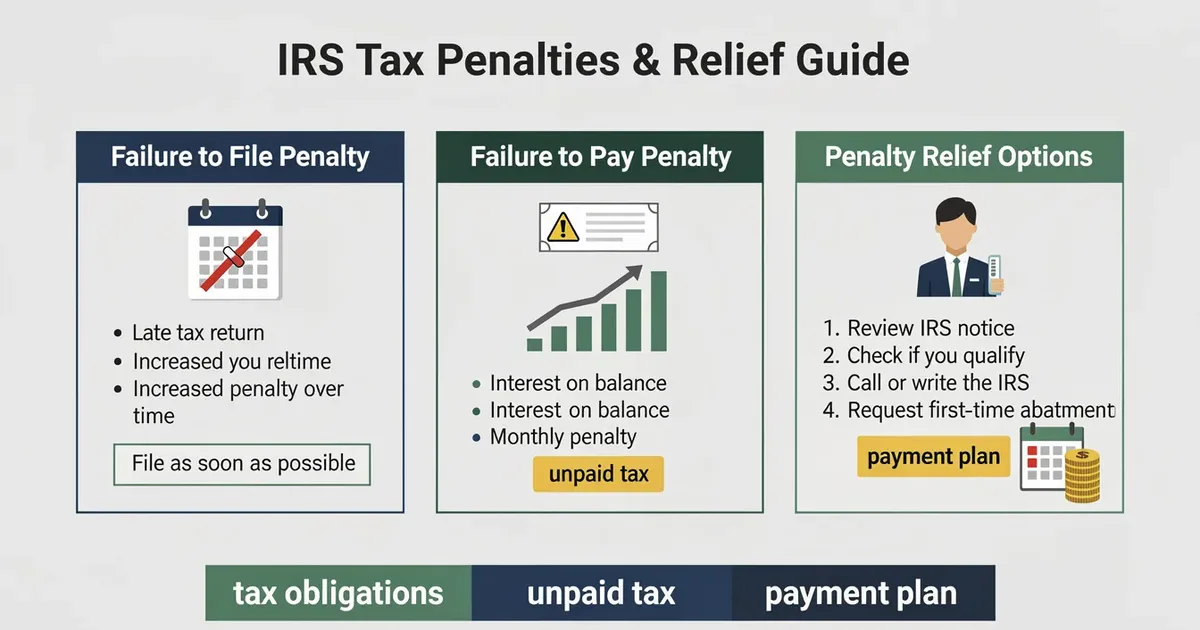
Penalties for IRS: Failure to File, Pay & Penalty Relief
Received an IRS notice about a penalty? This guide breaks down the most common IRS penalties in plain English, including how they are calculated and your options for relief.