
How do I stop IRS penalties and interest from growing?
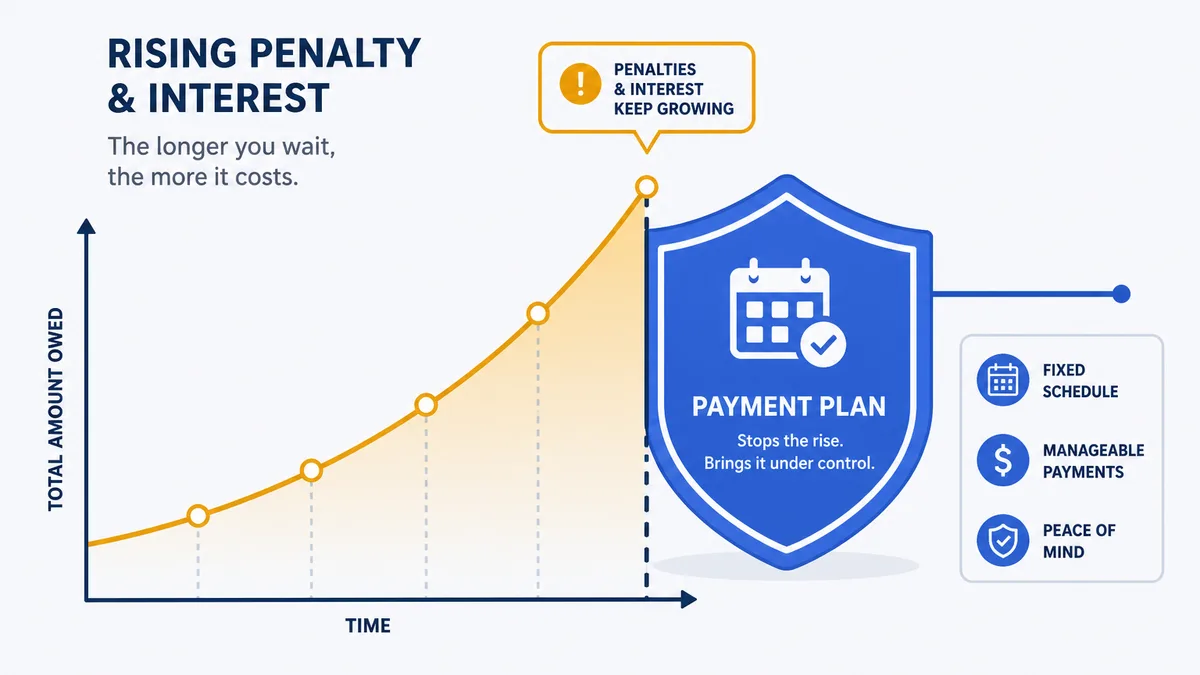
To stop IRS penalties and interest from growing in a lasting way, you must change what the account still owes or how IRS rules treat that unpaid tax. Full payment ends further failure-to-pay growth on the amount paid. A qualifying installment agreement can cut the monthly failure-to-pay rate. Approved penalty relief can remove some penalty dollars. Interest usually keeps running until the tax itself is paid. Marketing promises that “freeze” everything without payment or a real agreement are myths.
What “growing” actually means on an IRS bill
A balance due notice such as a CP14 often lists tax, penalties, and interest as separate lines. Those lines do not move for the same reasons.
- Tax is the underlying amount the return or assessment says you owe.
- Penalties (such as failure to pay) are statutory add-ons that can rise by month while tax stays unpaid.
- Interest compounds on unpaid tax and, in many cases, on unpaid penalties, under published rates that change over time.
When people say they want to stop IRS penalties and interest from growing, they usually mean both the monthly penalty climb and the interest climb. Those two clocks are related, but they are not identical. Clearing tax stops more failure-to-pay on that tax. Clearing only a penalty line does not always stop interest on remaining tax.
Use ClearNotice’s penalty calculator to see how unpaid months can add cost before you decide whether to pay, arrange payments, or seek relief.
What truly slows or stops growth
1. Pay the tax (full or targeted)
Paying unpaid tax is the cleanest way to stop further failure-to-pay penalty from accruing on the amount paid. Interest generally stops accruing on amounts once they are paid. If you can clear the whole balance, growth ends for that module. If you can pay only part, apply payment carefully: tax-first thinking usually matters more than paying a penalty line while tax remains open.
Keep confirmation numbers, bank records, and the notice ID. Posting can lag. A temporary online balance that still shows old figures is not proof that growth somehow restarted after a good payment.
2. Enter a qualifying installment agreement
If you cannot pay in full, an installment agreement organizes monthly payments. Under common IRS failure-to-pay rules, the monthly rate can drop (often described as half the usual monthly rate) while you are under an installment agreement and meeting its terms. That is a real slowdown, not a full freeze.
Interest can still accrue. Future returns must stay filed and paid (or arranged) to keep many plans healthy. Default can return you to harsher collection posture and can undo the rate benefit.
3. Remove penalties you legally qualify to remove
Penalty abatement does not invent a pause button. It asks the IRS to remove or reduce specific penalty assessments when rules allow it. Two broad paths people discuss are:
- First time penalty abatement for qualifying failure-to-file, failure-to-pay, or failure-to-deposit penalties when compliance history and other criteria fit
- Reasonable cause relief when facts show you exercised ordinary business care and prudence but still could not meet a requirement
Approved abatement can shrink the penalty dollars on the account. It does not rewrite interest rules on unpaid tax. If tax remains, interest can continue.
4. Fix wrong assessments early
If the tax figure is wrong, growth on a bad number is still growth. Dispute paths, amended returns where appropriate, and account transcript reviews matter when the bill itself is the problem. Paying under protest is sometimes discussed with professionals when deadlines and collection risk collide. The point is simple: correcting liability is part of stopping needless add-ons, not a slogan.
Myths that do not stop the clock
Myth: “A phone call alone freezes everything”
A call can start a plan, clarify a balance, or point you to forms. A conversation without payment, an approved agreement, or approved relief does not, by itself, stop statutory growth.
Myth: “Fresh Start marketing pauses penalties for everyone”
Ads that wave a branded “fresh start” label often mix real tools (installments, currently not collectible review, offers in compromise, first time abatement) into one magic program. Those tools exist as separate IRS processes. None of them silently freezes interest on unpaid tax for every caller.
Myth: “If I cannot pay, growth must stop automatically”
Inability to pay in full is common. It does not auto-suspend failure-to-pay or interest. Currently not collectible status can pause active collection in hardship cases after financial review, yet interest can still accrue while that status holds.
Myth: “Deleting mail or changing addresses resets the meter”
Returned mail and outdated addresses create more risk, not less. Notices can advance while you never see them. Update your address with the IRS and keep opening mail.
Myth: “Paying a random amount each month is the same as a plan”
Voluntary irregular payments can reduce principal when applied, which helps. They are not the same as an installment agreement’s formal rate treatment and collection posture. If you can sustain a monthly amount, putting it inside a real agreement is usually clearer.
Levy warnings and final collection notices are not “growth myths.” If a letter sets a date after which the IRS may levy wages or bank accounts, treat that date as urgent. Setting up payment or speaking with the contact on the notice before levy action matters more than hoping penalties somehow pause on their own.
Practical sequence when cash is tight
- Confirm tax year, tax, penalty, and interest on the latest notice.
- Estimate the monthly cost of waiting with the penalty calculator.
- Pay what you can toward tax if a lump sum is close.
- If not, apply for an installment agreement you can keep.
- Check whether first time abatement or reasonable cause fits any penalty lines.
- If essentials leave no room for payments, explore currently not collectible with careful, honest financials.
This order keeps the focus on what changes IRS math: lower unpaid tax, better rate treatment under a plan, and legitimate penalty removal.
Interest versus penalties: why both matter
People sometimes celebrate a penalty waiver and then feel shocked when the balance still climbs. Interest is its own statute. Relieving a penalty can help, yet unpaid tax keeps interest alive. The reverse is also true: paying tax stops more failure-to-pay on that tax even if a separate penalty dispute is still open.
Read every notice line. Ask which dollars are tax, which are penalty, and which are interest. That split tells you what full payment, a plan, or abatement can each accomplish.
Business and trust fund caution
Employment taxes and trust fund recovery penalties follow stricter collection patterns. Personal “I will call later” habits are especially costly there. Licensed help early is often wiser than waiting for growth to teach the lesson.
Bottom line
You stop IRS penalties and interest from growing by changing the unpaid tax, securing rate treatment through a real installment agreement when you qualify, and removing penalties only when relief rules allow it. Myths about freezes, branding labels, and silence do not rewrite the code. Start with the bill (often a CP14), measure delay cost with the penalty calculator, then pick payment, plan, or relief based on facts you can document.
Quick follow-ups
Does opening a payment plan freeze all growth overnight?
No. An installment agreement can lower the monthly failure-to-pay rate in many cases, yet interest and remaining penalties can still accrue under IRS rules until the tax is paid.
Will first time abatement erase interest too?
First time penalty abatement targets qualifying penalties, not interest. Interest generally continues until the underlying tax is paid.
Is ignoring mail a way to pause penalties?
No. Unanswered balance notices usually leave the account open, so failure-to-pay and interest can keep adding while collection steps get stronger.
Upload a photo for a free plain-English explanation of your amounts, deadline, and options.

Founder of ClearNotice · Updated August 2026 · About