
What is first time penalty abatement and do I qualify?
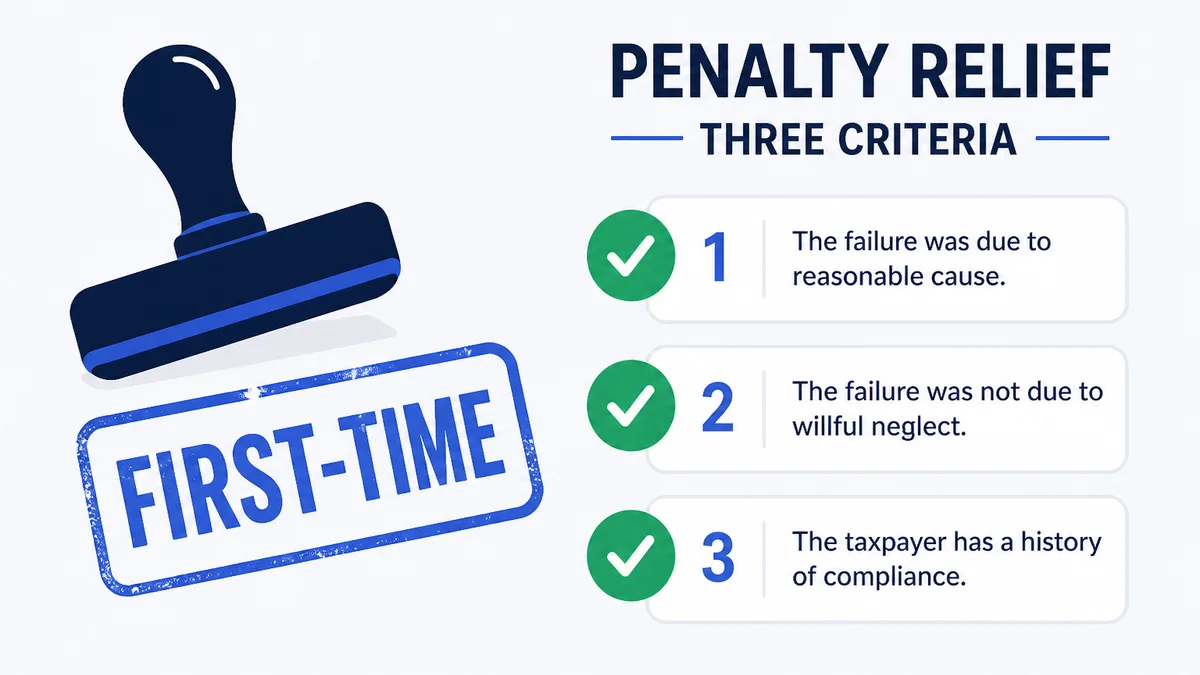
First time penalty abatement is an IRS administrative waiver for certain failure-to-file, failure-to-pay, and failure-to-deposit penalties when you meet a short list of compliance tests. It is not a general pardon for every balance, and it does not cancel interest. If you qualify, it can remove a painful penalty line. If you do not, reasonable cause or fixing the underlying tax may still matter.
Plain definition
First time penalty abatement (often shortened to FTA) is a one-time courtesy the IRS may grant when your recent compliance record is clean and you are otherwise caught up on filing and payment requirements for the period at issue. Think of it as a “clean history” waiver for specific penalty types, not a marketing coupon and not a rewrite of your tax.
It commonly comes up after a first balance notice such as a CP14 shows failure-to-pay dollars growing beside the tax. Before you ask, separate tax, penalty, and interest on the page. FTA only targets qualifying penalties.
The three real criteria (in everyday language)
IRS publications and practitioner summaries describe FTA around three practical tests. Details can vary by penalty type and tax period, so treat these as the core checklist, then confirm against your transcripts and the notice.
Criterion 1: You filed what was required (or properly extended)
For the period tied to the penalty, required returns should be filed, or you should have a valid extension in place when the rules call for one. FTA is not meant to paper over years of missing returns. If returns are still outstanding, file them first. Relief talks go better when the account shows the returns the IRS expects.
Criterion 2: You paid or arranged to pay the tax due
FTA does not replace paying tax. You generally need to have paid the tax, or be under an arrangement the IRS accepts for that tax, for the relief request to fit. A waiver of a failure-to-pay penalty while ignoring the tax itself is not the point of the program. If cash is tight, couple any FTA request with a realistic installment path rather than hoping the penalty vanishes and the tax somehow waits forever.
Criterion 3: Clean penalty history for the look-back window
FTA looks at whether you already had similar penalties assessed in a prior multi-year window (commonly described as the prior three years of similar penalties, with estimated tax penalties treated differently). If that history is not clean, FTA is usually closed and you shift to another theory such as reasonable cause.
These three tests are the heart of “do I qualify?” Fancy storytelling does not replace them.
Which penalties FTA can cover
In typical individual and business use, FTA is discussed for:
- Failure to file
- Failure to pay
- Failure to deposit (employment tax contexts)
It is not a blanket eraser for accuracy-related penalties, fraud penalties, trust fund recovery penalties, or every add-on that can appear on a transcript. If your notice shows a penalty type outside the FTA family, ask whether reasonable cause or another specific relief path applies instead.
What first time penalty abatement does not cover
Be clear before you invest hours:
- Interest: FTA does not turn off interest on unpaid tax.
- The tax itself: The underlying liability remains unless you pay it, successfully dispute it, or resolve it through another program.
- Every year forever: It is a first-time style waiver, not an annual subscription.
- Bad facts dressed up as hardship: If you simply chose not to file or pay without a compliance basis, FTA will not invent eligibility.
- Collection urgency by itself: A levy warning creates urgency to act. It does not automatically grant FTA.
Estimate how much the penalty line matters with the penalty calculator, then decide whether FTA, reasonable cause, payment, or a plan should come first.
How to request it
Option A: Call the number on the notice
Many taxpayers request FTA by phone. Have ready:
- Social Security number or EIN
- Tax year and form
- Notice number
- A short statement that you are requesting first time penalty abatement
- Confirmation that returns are filed and tax is paid or under arrangement
Ask the representative to note the request and tell you what happens next. Write down the date, time, and any reference number.
Option B: Write a short request
A concise letter or fax (when the notice allows) can work. Include identity details, the tax period, the penalty you want removed, and a clear sentence requesting first time penalty abatement based on your clean history and current compliance. Attach a copy of the notice. Keep proof of mailing or transmission.
Option C: Work through a licensed professional
CPAs, enrolled agents, and tax attorneys often request FTA while reviewing transcripts. That helps when multiple years, mixed penalty types, or business deposits are involved.
You usually do not need a ten-page biography. You need accurate periods, accurate penalty names, and facts that match the three criteria.
Do not wait for FTA while a collection deadline on a later notice approaches. A pending relief request is not a shield against levy if you ignore dates on final collection letters. Pair any abatement request with payment, an installment agreement, or other timely contact when collection risk is active.
If you do not qualify
Failing FTA is common and not the end of the path.
- Reasonable cause may still apply when illness, disaster, bad reliance on wrong advice in limited settings, or other documented events show ordinary care was not enough to avoid the failure.
- Correcting the account may remove a penalty that never should have posted.
- Paying tax sooner still stops more failure-to-pay growth even when a waiver is denied.
Reasonable cause is evidence-driven. FTA is history-driven. Know which story you are telling.
How FTA fits beside payment plans
Some people qualify for FTA and still need months to clear tax. Others get the penalty removed and can pay the rest quickly. Either way, model the remaining balance. ClearNotice’s penalty calculator helps you see what still grows if tax stays unpaid after a penalty comes off.
If your first letter is a balance bill, read the CP14 guide so you know which lines are eligible candidates before you call.
Quick self-check before you dial
- Which exact penalty codes or descriptions appear on the notice or transcript?
- Are all required returns for that period filed?
- Is the tax paid or under a formal arrangement?
- Did similar penalties appear in the recent look-back years?
- Have you already received FTA for another period?
Honest answers prevent wasted calls and point you toward FTA, reasonable cause, or simple payment strategy.
Bottom line
First time penalty abatement is a real IRS administrative waiver for certain filing, paying, and deposit penalties when filing is current, tax is paid or arranged, and your recent penalty history is clean. It does not erase interest, rewrite tax, or cover every penalty type. Check the three criteria, request clearly by phone or mail, and keep collection dates on your calendar while the request is pending.
Quick follow-ups
Can I use first time penalty abatement more than once?
It is designed as a one-time administrative waiver for a clean recent history. After you receive it, later periods generally need another basis such as reasonable cause.
Does first time penalty abatement remove interest?
No. It addresses qualifying penalties. Interest on unpaid tax generally continues until that tax is paid.
Do I need a long letter to request it?
Many requests start with a phone call to the number on the notice or a short written request naming the tax period and penalty. Keep filing and payment facts ready.
Upload a photo for a free plain-English explanation of your amounts, deadline, and options.

Founder of ClearNotice · Updated August 2026 · About