
Should I amend return after IRS notice?
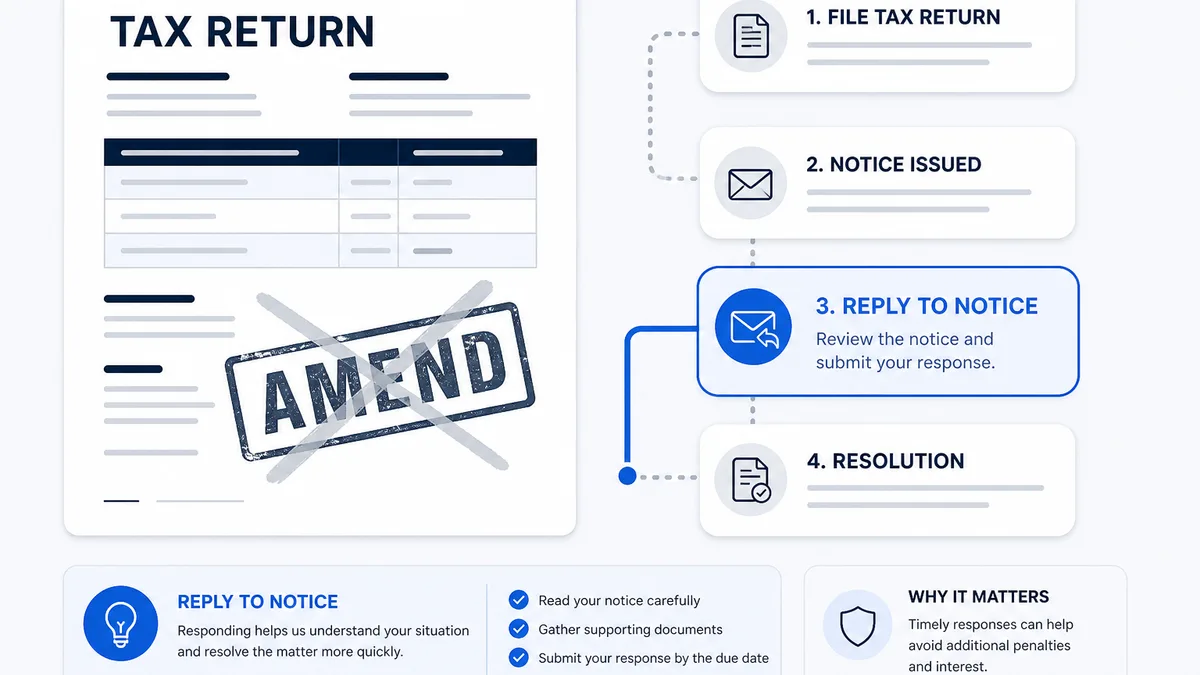
When you ask whether to amend return after IRS notice correspondence, the usual answer for underreporter mail is that a complete, on-time response to the notice is the main path. Form 1040-X is sometimes still useful for separate errors or for years the notice does not fully repair. Amending first and skipping the notice reply can leave deadlines unmet. Match the tool to the letter in front of you.
What the notice is already trying to do
Underreporter notices such as a CP2000 propose specific changes based on third-party reports. They invite you to agree, partially agree, or disagree. If the IRS accepts your reply, or if you agree and the proposal is assessed as described, the agency’s account for that year can update without you filing a separate amended return.
In other words, the notice process is already a structured way to correct certain income mismatches. That is why “should I amend?” is not automatically “yes.” For the broader first-week plan, see IRS says I underreported income.
When responding to the notice is usually enough
The letter only disputes income the IRS already listed
If the entire problem is a 1099 the IRS printed on the notice, your job is typically to:
- Confirm or correct those lines with documents
- Complete the notice response pages
- Pay or arrange payment for any amount you accept
A well-built reply package, such as the patterns in ClearNotice’s sample response guide, often covers that lane. Deep evidence tips live in how to dispute IRS underreported income.
You agree with the proposal as written
Agreement through the notice can assess the additional tax, penalties, and interest the letter computes (subject to IRS processing). Filing Form 1040-X to restate the same agreed change may add little, and can create version confusion if the numbers are not identical.
You partially agree and the notice instructions support that path
Partial agreement is normal. You accept some lines, dispute others, and attach proof. The notice framework is built for that split. An amendment is not required merely because the outcome will be mixed.
When an amended return may still help
Errors the notice never mentions
Suppose the CP2000-style letter only adds bank interest, but you also realize you claimed the wrong filing status credit, omitted a dependent-related form, or misreported withholding unrelated to the notice table. Those issues may sit outside the underreporter proposal. A licensed professional can help you decide whether Form 1040-X, a separate IRS correspondence path, or waiting for the notice to close is cleaner.
You need to change credits or schedules tied to corrected income
Sometimes correcting income affects credits, deductions, or self-employment computations in ways the notice’s simplified tax recomputation does not fully mirror for your facts. That is more common when gig work, multi-state returns, or layered credits are involved. Drivers sorting platform forms can compare context in IRS notice gig income, then ask a professional whether amendment timing should follow the notice close.
The IRS instructs you to amend
Occasionally a letter explicitly tells you to file an amended return for a defined reason. When the page says so, follow that instruction and keep a copy with your notice file.
You are fixing a year that is not the notice year
People sometimes open a notice for 2023 and remember a separate problem for 2022. Amending 2022 does not answer the 2023 notice deadline. Treat each year as its own project.
Risks of amending by reflex
Duplicate or conflicting figures
If you mail Form 1040-X with one income total while your notice reply uses another, reviewers may need extra cycles to reconcile. Consistent worksheets across both filings matter if you truly need both.
Missed notice deadlines while you rebuild a full 1040-X
Amended returns take time to prepare, especially with states. The notice’s respond-by date does not pause while you gather every possible correction. Send the required notice response first when the letter demands one.
False sense of closure
Filing 1040-X feels proactive. It does not automatically stop assessment on an unanswered CP2000-style proposal. Closure comes from the process the notice describes, plus any later IRS determination mail.
If your notice lists a response deadline, treat that date as controlling for the underreporter proposal. Do not wait on amended-return software imports alone. A late reply can allow the IRS to assess its proposed figures even if a 1040-X is in progress.
A simple decision frame
Ask four questions:
- Does the notice ask for a signed response by a date?
- Do my only corrections match the income lines already printed on the notice?
- Are there material errors outside those lines?
- Has a CPA, enrolled agent, or tax attorney reviewed whether 1040-X adds value after or beside the reply?
If answers are yes, yes, no, and no professional need yet, lean toward notice response only. If question 3 is yes, plan the amendment carefully so it does not conflict with the notice math.
Practical sequencing many people use
- Calendar the notice deadline.
- Build the agree, partial agree, or disagree package.
- Submit that package with exhibits.
- Separately list any non-notice errors.
- Decide on Form 1040-X with professional input if those errors are material.
- Keep one folder with the notice, the reply, and any amendment confirmation.
This sequence protects the deadline without blocking later cleanup.
State returns and “one more form”
Federal notice changes can affect state taxable income. Some states assess from federal changes automatically; others expect a state amended return. Check your state’s rules after the federal notice path is clear enough to know the final federal income figures. Filing a rushed state amendment on guessed numbers can create a second cleanup project.
When licensed help is the better default
Amend-versus-respond choices get harder with business returns, prior audits, innocent spouse claims, bankruptcy overlays, or penalty abatement strategies tied to the same year. A CPA, enrolled agent, or tax attorney can map the sequence so you do not file overlapping corrections. ClearNotice helps you understand the notice type and organize a reply. It does not replace personalized filing strategy.
Short checklist
- Read whether the notice requires its own response
- Do not assume Form 1040-X replaces that response
- Use the notice path for printed underreporter lines
- Consider 1040-X for separate, material errors
- Keep federal and state timing consistent with final figures
Should you amend return after IRS notice mail? Often you should answer the notice first and amend only when something important sits outside that process. Matching the tool to the letter keeps deadlines intact and reduces conflicting paperwork.
Quick follow-ups
Does a CP2000 require me to file Form 1040-X?
Often no. Many underreporter issues are resolved by responding to the notice with agreement or disagreement and documents. Read your letter’s instructions before amending by default.
Can amending replace a required notice reply?
Do not assume it does. If the notice asks for a signed response by a date, follow that process even if you also consider an amendment for other reasons.
What if I find a second error while answering the notice?
List the extra issue separately. Ask a licensed professional whether the notice reply, an amended return, or both best updates that year without duplicate or conflicting figures.
Upload a photo for a free plain-English explanation of your amounts, deadline, and options.

Founder of ClearNotice · Updated August 2026 · About